

Over the past 5-10 years, we’ve seen an increasing number of airline and hotel loyalty programs move to a dynamic pricing model for award bookings (i.e. reservations made using your points or miles).
We refer to dynamic pricing regularly on the site, but perhaps you’re not entirely sure what it means. In this post we’ll be exploring what dynamic pricing is, as well as both its positives and negatives.
What is dynamic pricing?
You might be more familiar with the concept of dynamic pricing when it comes to cash pricing. For example, when you’re looking to book a plane ticket with cash, the price you see one day might be different from the price you see the next day or even the price you see minutes or hours later. Demand increases and decreases, so prices often rise and fall accordingly.
A similar thing happens with concert tickets. If an artist announces a tour, the ticket prices you see initially might be different than the prices you see later on as Ticketmaster assesses demand and how much the artist’s fans are willing to pay for seats.
Likewise, if Taylor Swift announces a new tour, it’s safe to assume that hotels near concert venues where she’ll be playing will jack up the prices for that night, and possibly the night or two either side of her performance too.
So how does this work with award bookings? Well, hotel and airline loyalty programs historically had fixed award charts. A one-way award flight anywhere in the US often cost a fixed 12,500 miles. An award night at a hotel might’ve cost 20,000 points every night of the year provided there was availability, regardless of how much the room rate for that room was. If you booked a hotel early enough using points when there was a big event in a city (e.g. Comic-Con, the Kentucky Derby, the Superbowl, etc.), you could get a screaming deal compared to the cash rates.
This meant that hotels and the loyalty programs they participate in were leaving money on the table, as were airlines. As a result, the majority of airline and hotel loyalty programs have moved to dynamic award pricing in recent years to one extent or another. This means that when cash pricing increases, the number of points or miles you need to redeem also increases.
Positives & negatives of dynamic award pricing + how to mitigate it
That description of dynamic award pricing might sound like unalloyed bad news. It does indeed have negative features in many ways, but there can also be positives to it. There are also some ways to help mitigate it, so here’s a look at all those aspects.
Potentially uncapped award pricing
If cash pricing is (theoretically) uncapped, it means that with true dynamic award pricing the number of points or miles you need to redeem is uncapped.
In reality, that’s rarely the case. For example, while Hilton award pricing can often be excessive, their awards do—at the time of publishing this post at least—top out at 250,000 points per night for a standard room award, although the majority of their properties max out at 150,000 points per night and oftentimes much less than that.
Increased award availability (perhaps)
One potential benefit of dynamic award pricing is that it means loyalty programs can, in theory, provide more award availability.
With fixed award pricing, there were usually a limited number of base level hotel rooms or hotel seats that were bookable with points and miles. Once that allotment was taken, that was it—there was no more award availability unless someone cancelled their booking and/or more award space was made available at the last minute (more common with flights than hotels).
With dynamic award pricing though, loyalty programs can, theoretically, make all hotel rooms and airplane seats bookable with points/miles, with the redemption rate being somewhat tied to the cash price of said rooms/seats. Not all programs do that for one reason or another, whether that’s simply out of no desire to or due to IT system constraints.
One well-known example where this is possible is the Hilton Honors program. If you do a search for points pricing at any given hotel, you’ll likely see two types of pricing. One is a Standard Room Award which costs a “regular” number of points, with that amount usually—but not always—being dynamic. Some hotels only have one room type bookable as a standard award, but others have multiple room types.
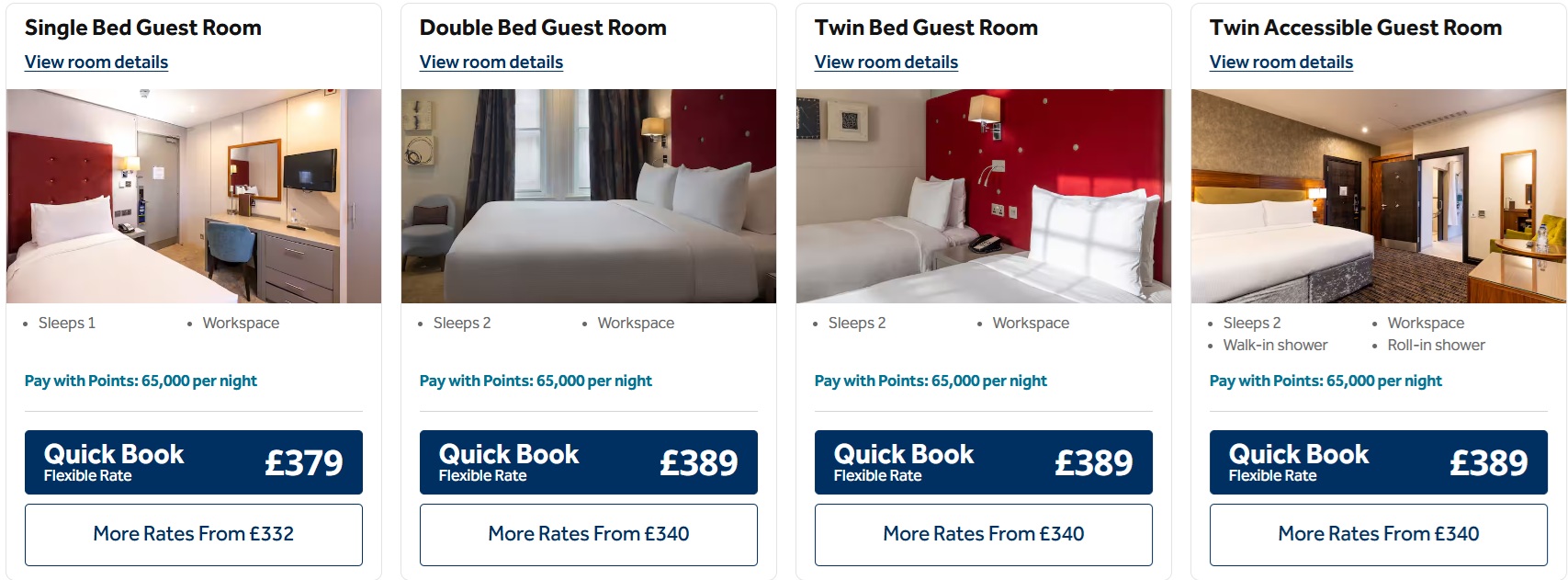
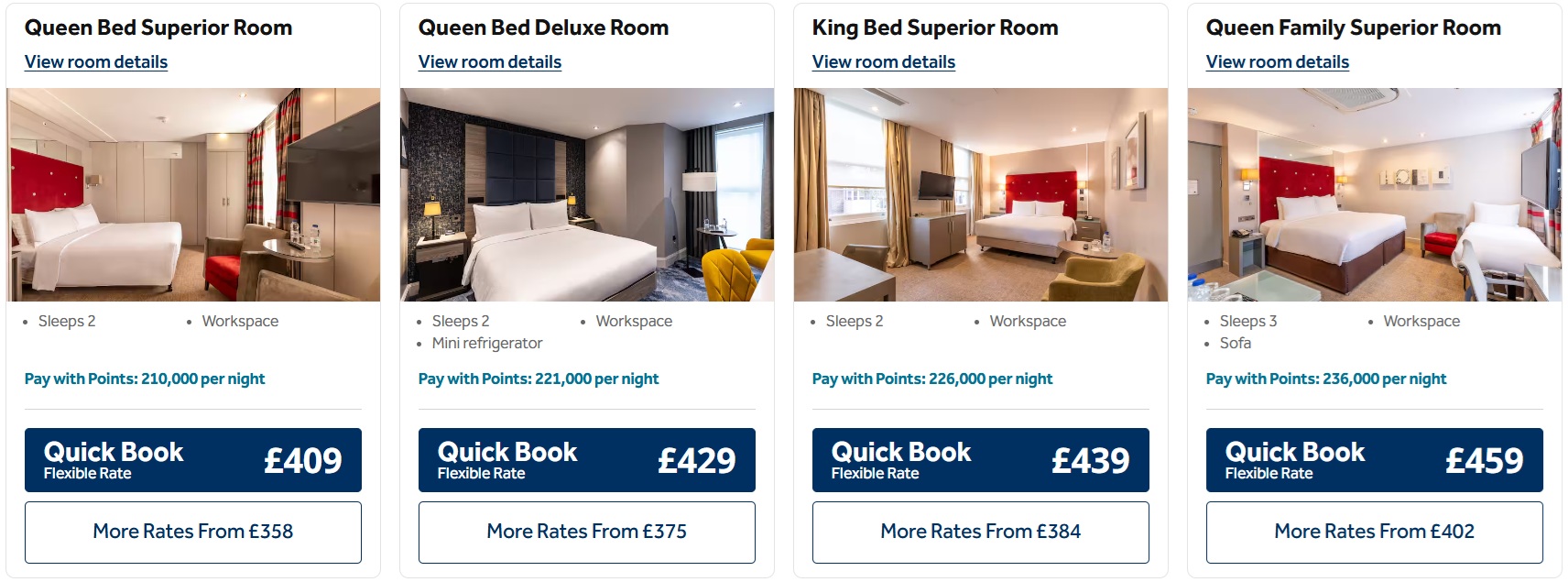
Non-standard room types are also bookable, albeit at a vastly inflated price that usually isn’t directly tied to the cash room rate; Hilton calls these Premium Room Awards. For example, a Queen Bed Superior Room at the same property only cost £30 more per night (i.e. less than 10% extra) for the dates I searched, but award pricing was more than triple that of a standard room.
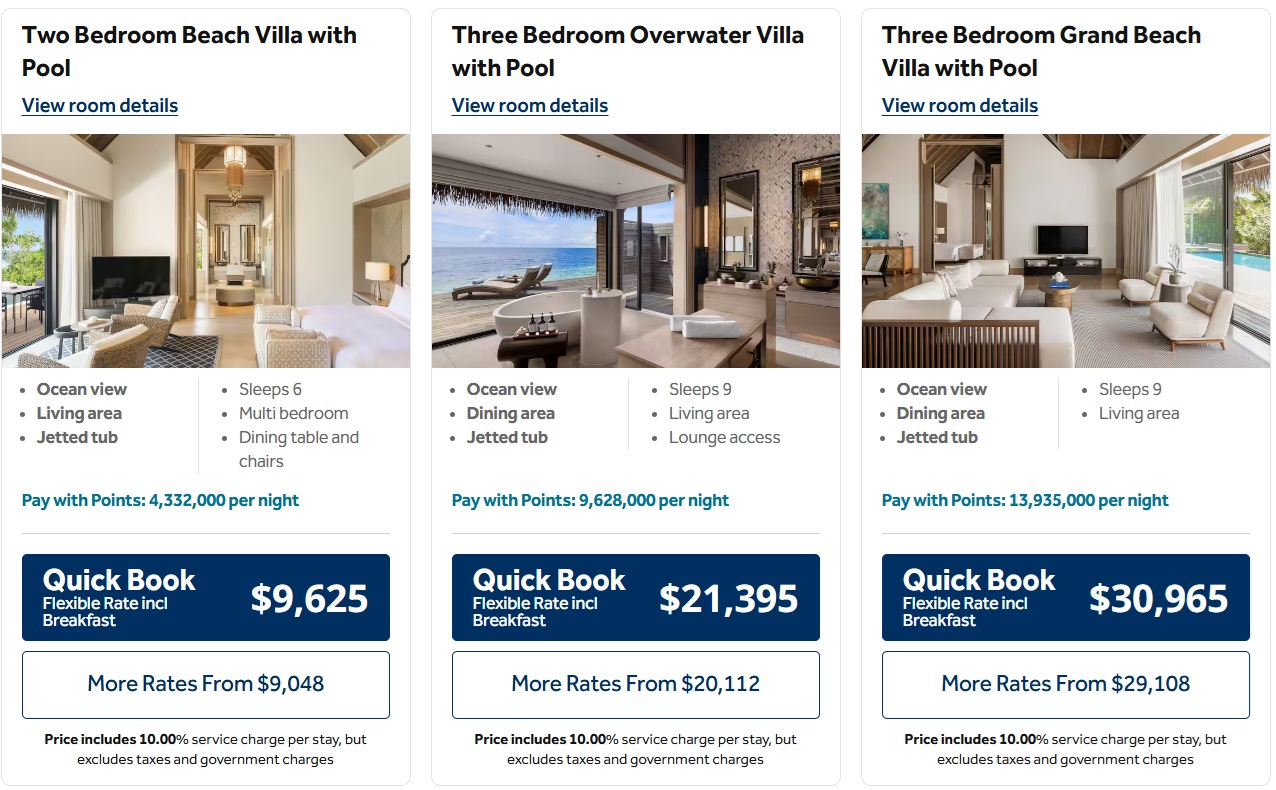
That kind of dynamic award pricing can become even more ridiculous. For example, it’s possible to book a Three Bedroom Grand Beach Villa With Pool at the Waldorf Astoria Maldives Ithaafushi, but it’ll cost you just shy of 14 million Hilton Honors points per night.
Harder to get outsized value (but not impossible)
When a loyalty program has a fixed award chart, it can be easy to identify points redemptions where you’ll get outsized value as it’ll be those that otherwise have a high cash cost.
Dynamic award pricing makes that much harder because the number of points you have to redeem fluctuates up and down depending on the cash cost.
Having said that, although it’s harder to get outsized value, it’s by no means impossible. That can sometimes be found at the top end of redemptions where there’ll often be some semblance of a cap on award pricing despite even higher cash pricing.
Other times, it can come at the low end. For example, Hyatt’s just revamped redemptions in its loyalty program and although it technically still has an award chart, it’s moved to dynamic pricing in all but name. Its cheapest redemptions—Lowest in category 1—will be bookable for only 3,000 points per night. If you can find availability at that level, you’re pretty much guaranteed to be getting at least 2 cents per point of value from the redemption, if not significantly more.
Other times, dynamic pricing doesn’t always match cash fares. For example, take this American Airlines flight from Norfolk, VA to New York LaGuardia. Award flights that day range from 7,000-32,000 miles one way. This is the only option bookable at 7,000 AAdvantage miles:
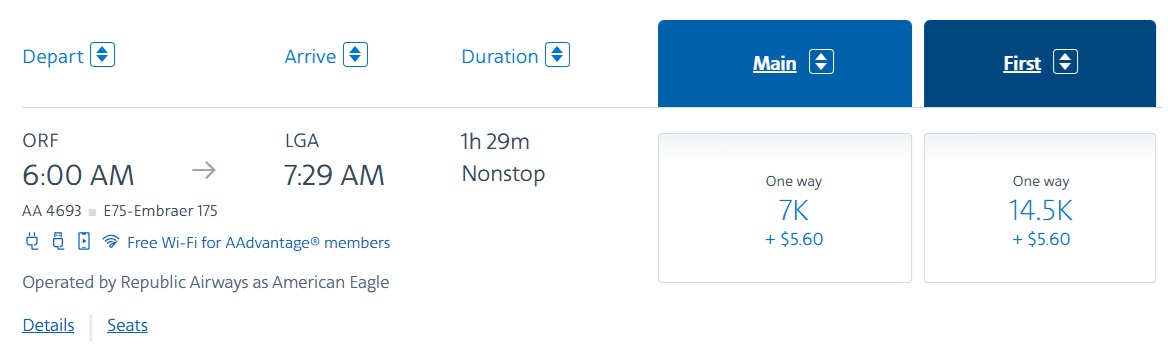
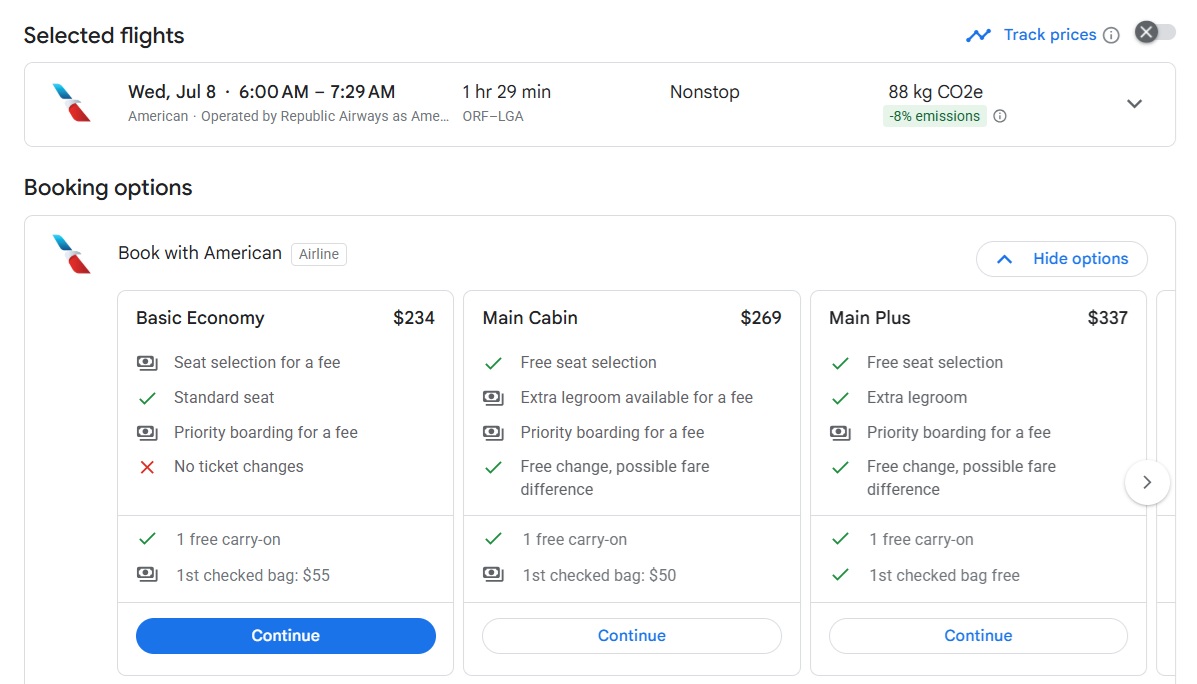
Despite being the cheapest award flight, it’s not the cheapest cash fare for American Airlines flights that day. In fact, it would cost $269 for an equivalent flight in Main Cabin, so a 3.75 cents per point redemption.
Some hotel free night certificates become better value
Quite a lot of hotel credit cards offer some kind of free night certificate at renewal and, occasionally, through other means such as via a big spend bonus on a credit card, earning a certain number of elite night credits, etc.
Depending on the hotel program, dynamic pricing means your certificates can get outsized value. More specifically, with Hyatt and Hilton you can get outsized value; with IHG and Marriott you can’t.
With IHG and Marriott, the reason you can’t get outsized value is because their certificates are issued for a specific number of points. While they can, in most instances and to some extent, be topped up with points to book award nights costing more than the certificates themselves are worth, you can’t get more value than the specific certificate points value.
Hyatt and Hilton free night certificates work differently. With Hyatt, they’re valid for category 1-4 hotels or category 1-7, depending on the type of certificate (they also have an Ultimate Free Night Award which can be redeemed at any property, but that requires 150 elite night credits per year).
Before their award chart update on May 20, 2026, category 4 Hyatt properties cost 12,000, 15,000, or 18,000 points per night depending on if they were at off-peak, standard, or peak pricing respectively. With the award chart change, those same category 4 properties will now cost between 12,000-25,000 points. If you needed to book an award at a category 4 hotel for a ‘Lowest’ night that costs 12,000 points, it’ll generally be better to redeem points rather than a free night certificate unless it’s getting close to its expiry date. However, for ‘Upper’ or ‘Top’ awards that cost 22,500 or 25,000 points respectively, redeeming a certificate will be much better value than redeeming World of Hyatt points.
Hilton free night certificates can be even better value. Those can be redeemed for a free night at any property worldwide provided there’s a standard room bookable. With Hilton free night awards now going as high as 250,000 points per night, that can provide incredible value and help avoid the excesses of dynamic award pricing.
Award booking features can help bypass dynamic pricing
Several major hotel loyalty programs offer some kind of incentive to book longer stays by removing the cost of an award night when booking a certain number of nights.
Marriott’s is ‘Stay 5, Pay For 4’ whereby Marriott will remove the cost of the cheapest award night when booking in five night increments. This feature sadly doesn’t help bypass dynamic pricing as it’s the cost of the cheapest award night that gets removed.
Hilton and IHG do provide an opportunity to get outsized value though and can help you bypass dynamic pricing.
Hilton’s feature gives every 5th night free on award stays provided you have Silver status or higher, with the cost of the 5th night being removed, rather than the cheapest night like Marriott does. If you have flexibility with your stay dates and the 5th night is the most expensive night, having the cost of that night removed will help mitigate the impact of dynamic pricing.
For example, take a look at this breakdown of nightly award pricing for a Hilton property. If you were to stay from June 1-6, your total cost would be 228,000 points as the 39,000 points for the night of June 5 would be removed.
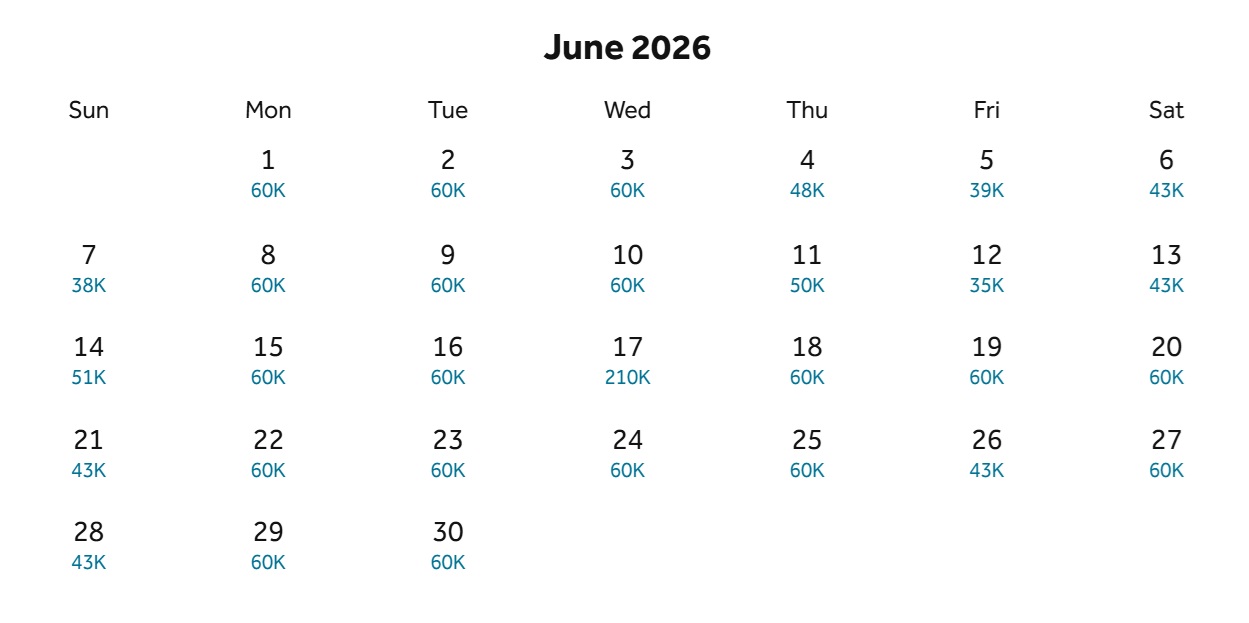
However, if you stayed from June 4-9, your total cost would be only 168,000 points. That’s partly because nights 1-4 are cheaper, but also because night 5 is the most expensive at 60,000 points and that’s the night where the points requirement is waived. That represents points savings of more than 25% (compared to the June 1-5 stay dates) by using flexibility to make dynamic pricing work for you.
IHG works in a somewhat similar way. If you have an IHG One Rewards Premier, Traveler, or Premier Business credit card, you get every 4th night free on award stays (rather than every 5th night like Hilton). If the 4th night is cheaper than the other nights then you won’t be saving as much, but if the 4th night is more expensive, that’s putting dynamic pricing to work for you.
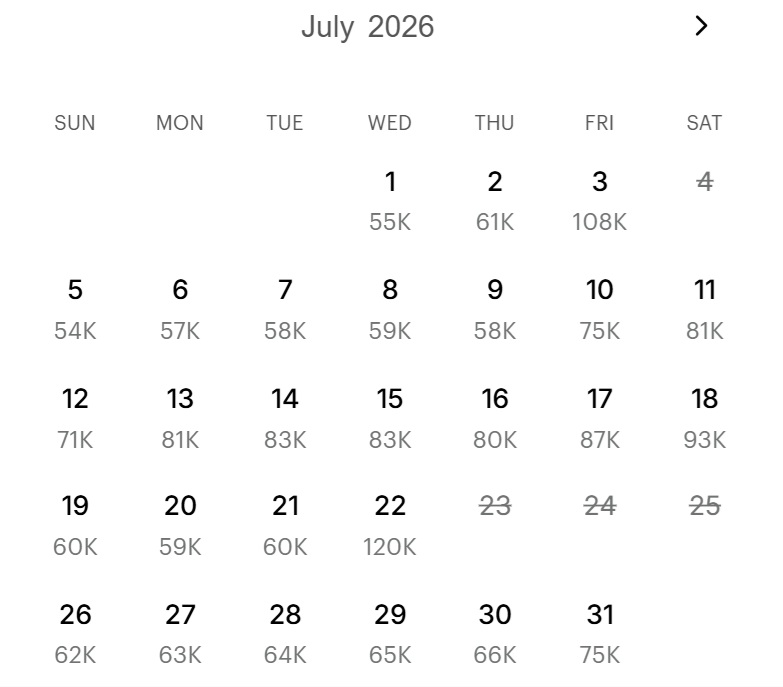
For example, here’s the nightly award pricing for an IHG property in July. If you were to book from July 19-23, the cost for the night of July 23—120,000 points—would be removed. That would have a huge impact on the number of points that would need to be redeemed seeing as the other nights are literally half that amount or less.
Monitor award pricing to benefit from pricing drops
One of the (almost) inevitable features of dynamic award pricing is that the cost of any given award will increase and/or decrease in price over time depending on what’s happening with the cash price of an equivalent booking.
This gives you an opportunity to make dynamic pricing work for you. Provided you’re not making a last minute booking, by monitoring your reservations after booking award stays or flights to see if the price has dropped, you can rebook them to take advantage of lower pricing if it occurs.
It’s important to be aware of cancellation policies before doing this though. Although most award stays booked with hotels are cancellable and refundable, that’s not always the case, particularly if you’re booking a stay at a hotel when there’s some kind of special event going on in the city.
Some airlines meanwhile have stricter cancellation policies than others. While some allow you to cancel awards and get a full refund of any taxes/fees paid as well as all your miles back, others charge a cancellation fee in order to get your miles back, while others refund the taxes/fees in the form of airline credit that expires after a certain number of months. Still, even if there is some kind of cancellation fee, that price might be worth paying if the value of the miles you’ll get back exceeds that cost.
There are a few tools you can use to help monitor for lower prices. Google Flights has a flight tracking feature, so you can set up alerts after booking an award flight to let you know if the cash price has dropped. There’s no guarantee that the award pricing will also drop accordingly unless it’s a program where the value of your points is more directly tied to the airfare (e.g. Southwest and JetBlue), but a drop in the cash price can be a good reminder to recheck award pricing.
Autopilot offers something similar, plus they’ll rebook you on the lower fare, but do note that’s only for paid fares, not award tickets.
On the hotel stays side of things, Gondola has a price tracking feature for both cash and award stays, thereby ensuring you’re notified if the required number of points drops in the future so that you can rebook using fewer points.
Your suggestions
What methods do you use to help mitigate dynamic pricing? Let us know in the comments below.
 Want to learn more about miles and points? Subscribe to email updates or check out our podcast on your favorite podcast platform.