In December, my family’s trip from Rovaniemi, Finland, to Frankfurt, Germany (via Helsinki) was disrupted when a delay on the flight from Rovaniemi to Helsinki caused a missed connection and forced an overnight stay in Helsinki. I previously wrote about how Finnair handled the delay, noting that they seemed to recognize their EU261 responsibility, which made me relatively confident that they would honor a claim for the €400 in compensation per passenger that we were due (on top of the hotel and meals they provided). I filed that claim and wanted to provide an update on the process and outcome.
Background
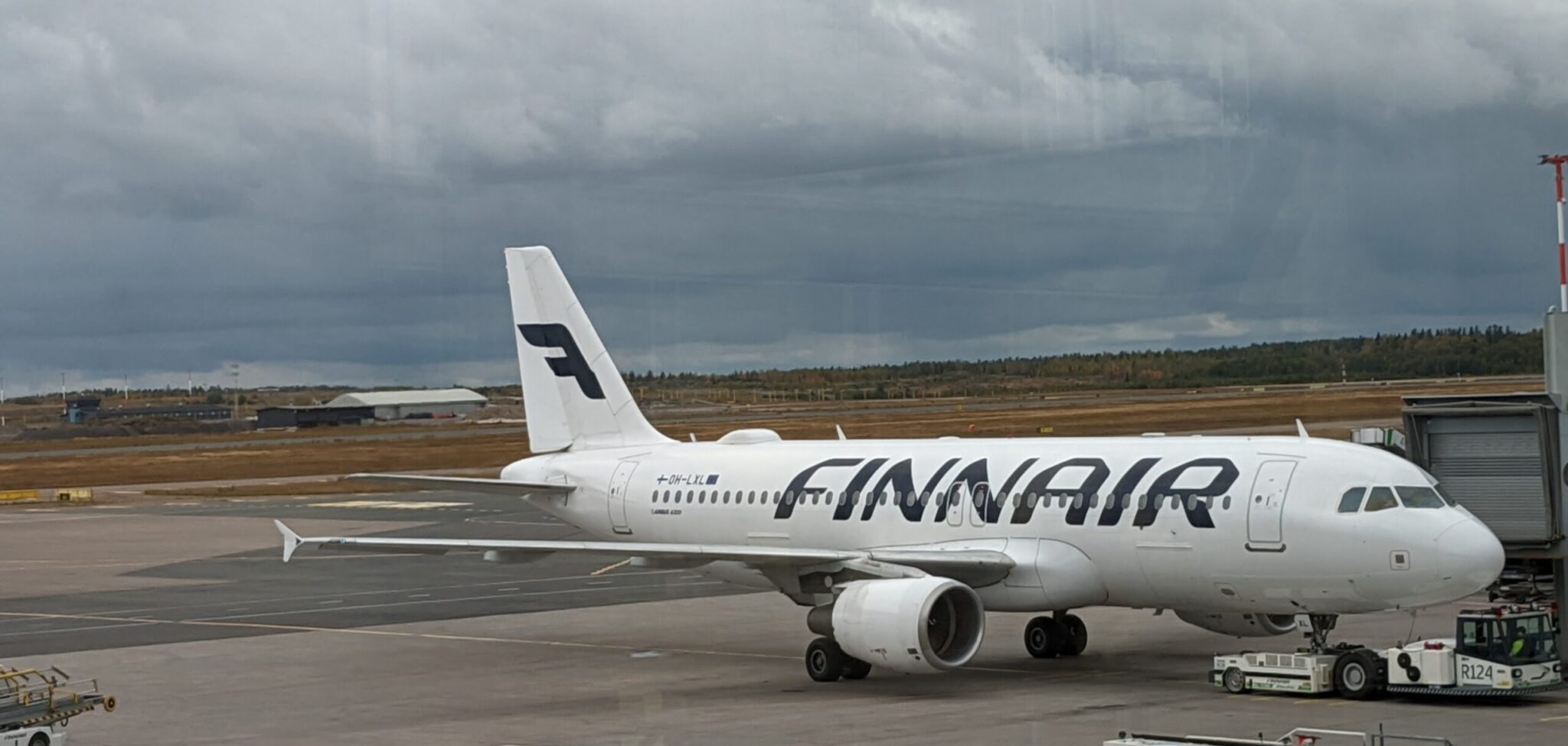
In December 2025, my family was booked to fly from Rovaniemi, Finland, to Frankfurt, Germany on Finnair. I had booked the four tickets using 7,500 Alaska Atmos points and $38.90 per passenger.
I previously wrote about getting stuck in Helsinki after a delay forced an overnight at the airport (having missed the connection to Frankfurt), and what Finnair did to take care of their responsibility in the case of a disrupted flight. In short, I was very impressed with how easy it was to book free accommodation, get free food at the airport, free meals at the hotel, and even free transportation to and from the hotel if we needed it. Kudos to Finnair; that whole process impressed me, and I wrote about it at length in this post. Read that post for more information on the things you need to know in the moment if you run into a similar situation with Finnair.
While I was impressed with how easy they made that part of the process, I also recognized that they were merely meeting their obligations under Europe’s EU261 Passenger Bill of Rights regulations. Similarly, under EU261, I expected my family to be eligible for compensation due to the delay. The amount of compensation due to each passenger varies based on the details of the itinerary and the length of the delay. Tim has written an excellent post outlining the full details of EU261 that makes for a great reference plate when you’re wondering what you are due. In my case, since this was an inter-European itinerary covering more than 1,500km, I figured my family was due €400 per passenger (times 4 passengers). That was in addition to having the hotel covered for the night, meals covered that night and the next morning, and transportation to and from the hotel if necessary. Again, you can read more about that part of the experience in my previous post.
Making a compensation claim with Finnair
I’d read a range of experiences with EU261, from Tim’s relatively pain-free experience with Singapore Airlines to reports detailing long waits, initial denials, and the need to follow up multiple times to receive compensation.
As a result, I was somewhat intimidated by the process. I frequently use Tripit to track travel plans, and I noted in my previous post that Tripit notified me that we were due compensation for that flight. The Tripit app offered to connect me with Air Help, which is a website that specializes in handling EU261 claims. If your claim is successful, their fee is a percentage of the claim (I believe it is 35%). I considered making a claim through Air Help, figuring that it might be worth the cost to reduce the time and effort required. At the same time, a 35% fee of what I expected to be a €1,600 claim would be significant. And since I write about this stuff for a living, I figured that most readers would be more curious about what the experience is like if you do it yourself.
I’m happy to report that the process was so simple that I’m really glad I didn’t sign up to pay €560 in this case.
Finnair compensation request forms can (almost) all be done online
Finnair makes the process of initiating a claim relatively easy to do online. Their materials suggest that they want you to file a claim within two months of the disruption, though I believe that we would have technically had at least a year to file.
I went here on the Finnair website to get started on my claim by selecting the button to apply for compensation for flight disruptions.
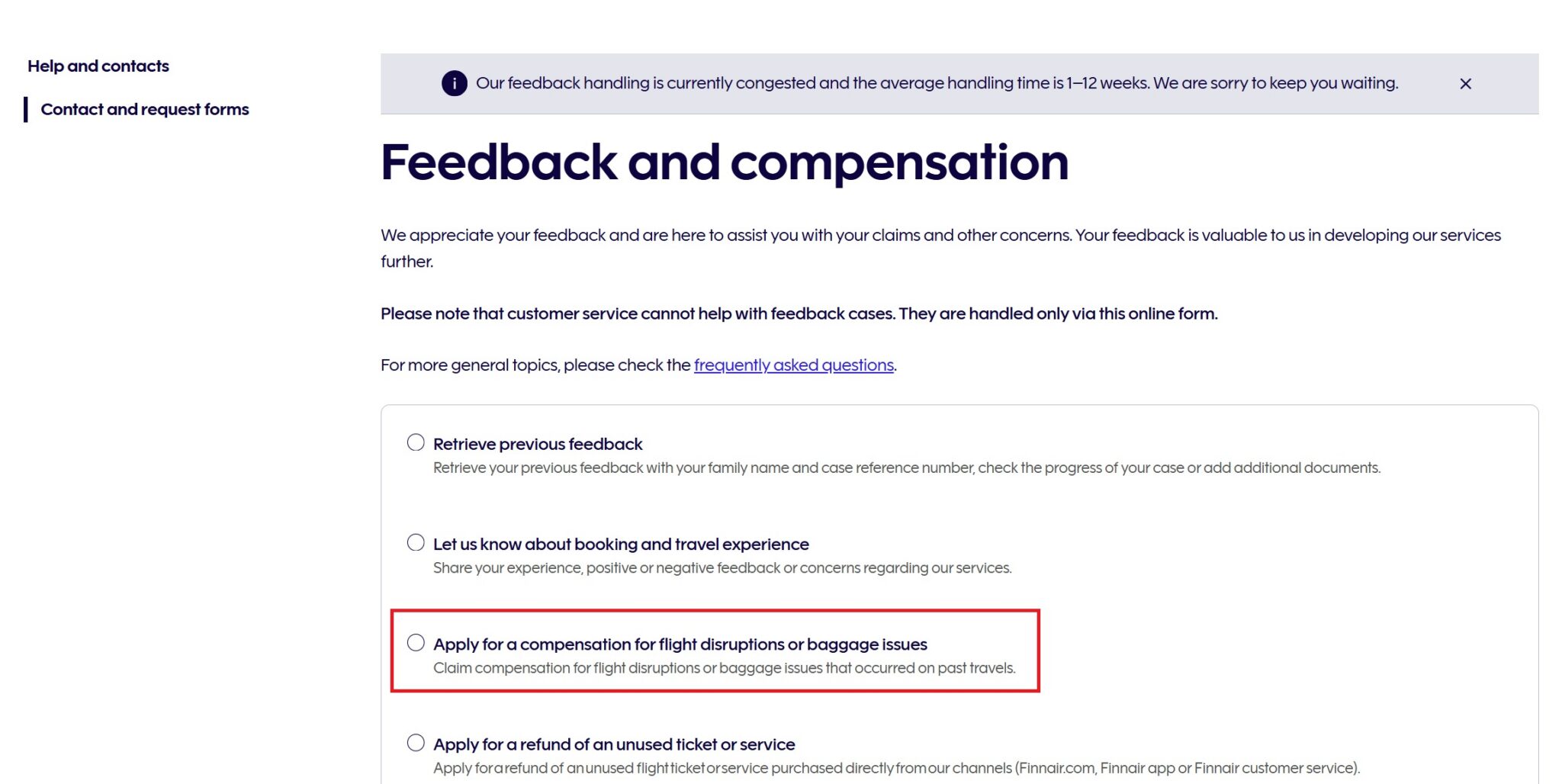
From there, it was straightforward. I had to enter my flight confirmation code and date along with origin and destination, but I didn’t need to add much explanation or documentation (for instance, I didn’t need the flight disruption statement that Tim got for his flight, and I didn’t need photos of boarding passes or other screenshots). Presumably, that’s because Finnair can pull all of the ticket and itinerary information from the confirmation code, so they don’t really need me to upload documentation proving the delay. If they had denied my claim and I had to follow up with Finnish authorities, I probably would have needed additional documentation, so I’m glad that I had lots of screenshots if I needed them, but I did not need to upload any of them.
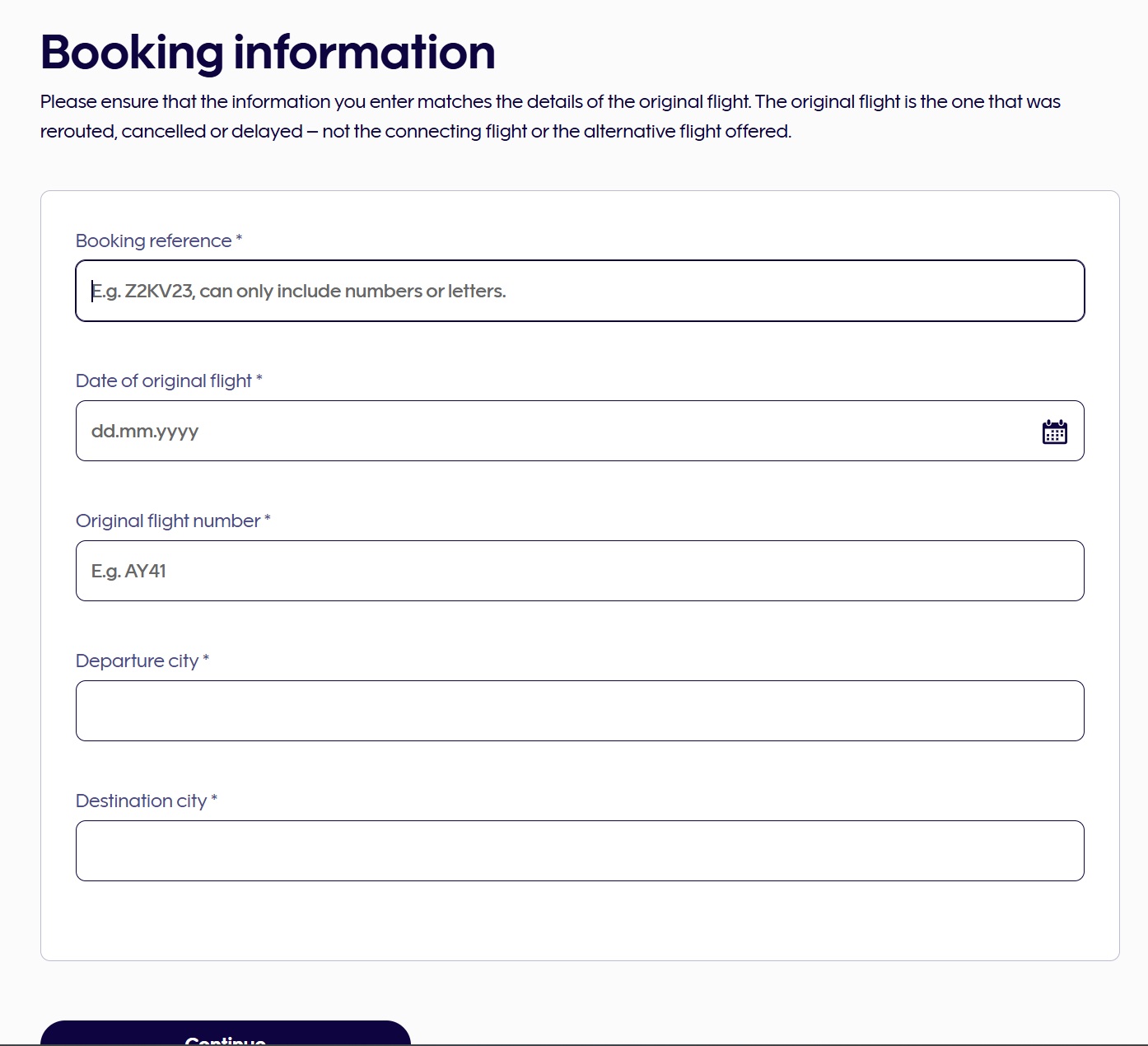
I next had to enter passenger information (name / date of birth / address / phone number / email). You can file separate claims for each passenger, or one passenger can file a claim for everyone on the itinerary.
The one pain point was that, in order for one passenger to file the claim for the group, we needed to upload signed copies of a power of attorney form (found here) signed by each passenger stating that the primary passenger is authorized to request and receive the compensation on their behalf. We had to submit those for the adults and the children on the itinerary. That said, it’s a really simple form. I printed copies, and after the forms were filled out, I took pictures of them with my phone, and we uploaded those pictures at that step in the process.
Finnair requires that your compensation claim be paid in the form of a gift card (for 50% more face value)
At the end of the submission process, I had to indicate how much compensation I was requesting. There are two key things to know here:
- You need to know how much compensation you are due. The system does not prompt you to select what you are owed, so you’ll want to research ahead to know how much to request.
- Finnair requires you to first receive compensation in the form of a Finnair gift card, but they provide a mechanism to turn the gift card into cash.
To that second point, Finnair requires a claimant to receive compensation in the form of a gift card, and Finnair adds 50% to the face value of the gift card. In other words, in this case, we were requesting €400 in compensation per passenger, so we selected compensation in the form of a €600 gift card per passenger.
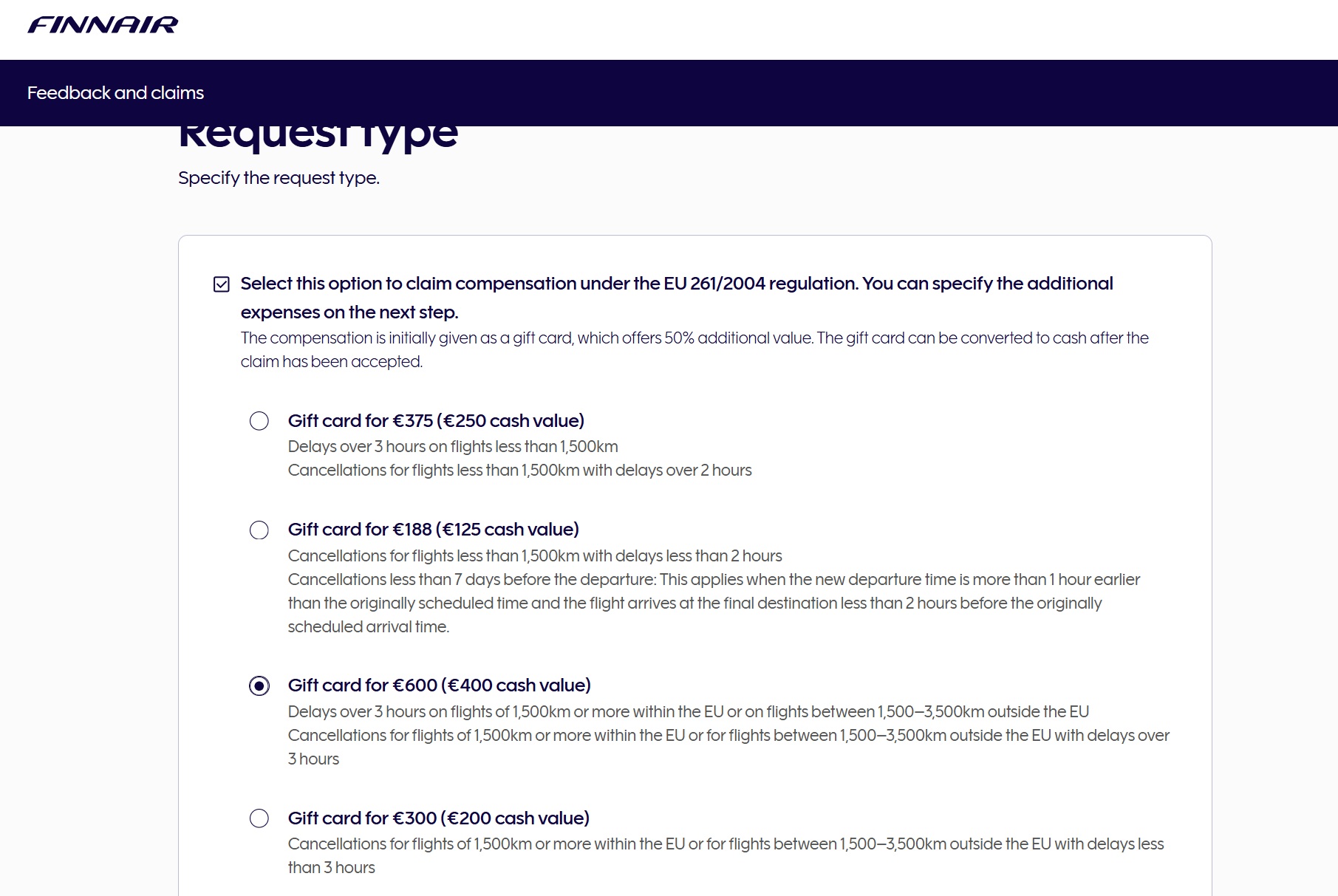
Because we filed all four passengers under one claim, that meant it would be for one lump claim for €2,400 in Finnair gift card money.
Success: My claim was approved in less than two weeks
We submitted the EU261 claim on Sunday, January 25th. Less than two weeks later, on February 6th, we received a response to the claim indicating that Finnair would indeed pay the requested compensation.
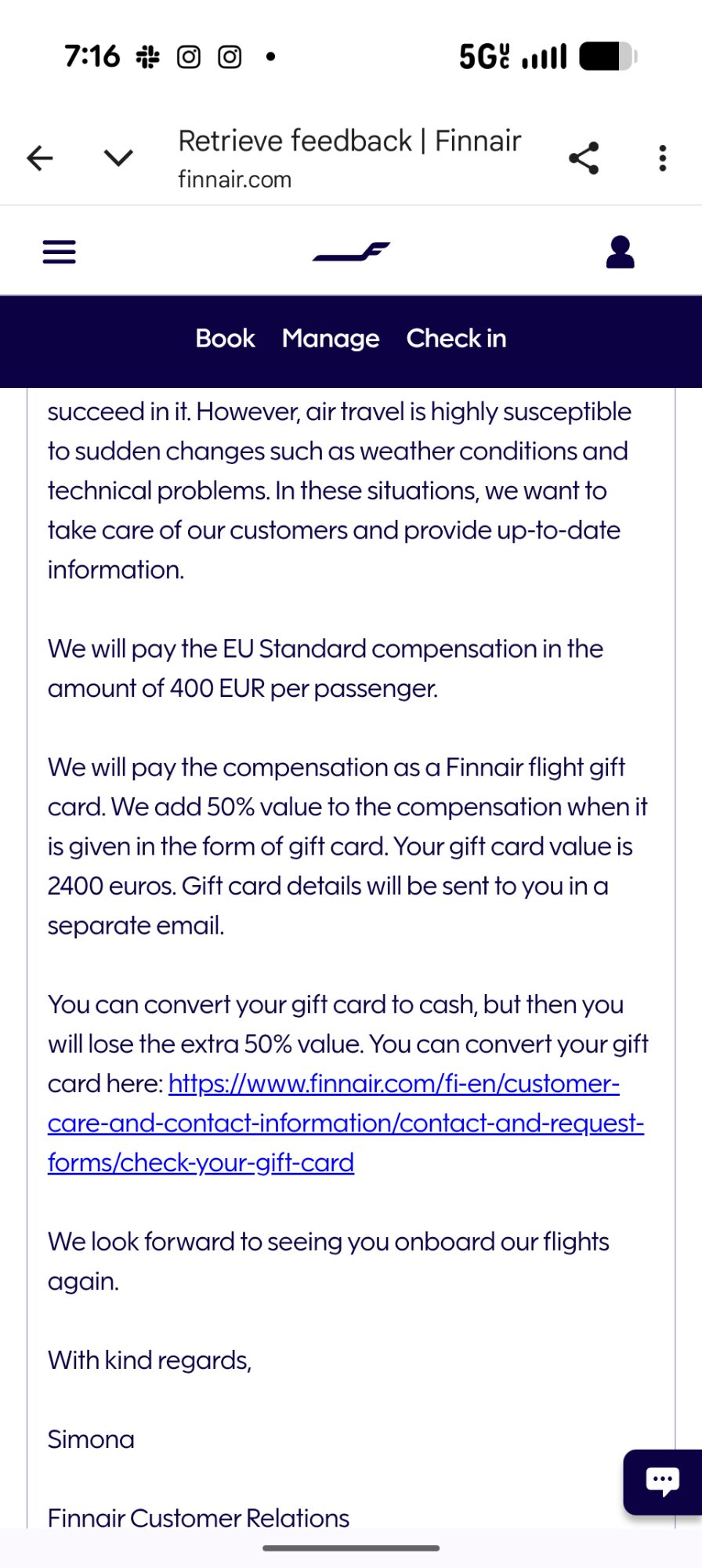
Since four passengers were due 400 EUR each (1,600 EUR total), Finnair indicated that we would receive a gift card good for 50% more value for a total of 2,400 EUR.
The gift card itself arrived separately three or four days later in an email with the subject line, “Here is your Finnair gift card”.
Converting a Finnair Gift Card from EU261 compensation to cash
The good news is that Finnair provides a simple mechanism for converting your gift card to cash. The email with the gift card information included a link to check the balance or convert the gift card to cash.
According to the terms, if we had used any part of the gift card, it would no longer be convertible to cash. We weren’t interested in an airline credit for Finnair that expires in a year, so we requested cash.
The process to convert the gift card to cash was also relatively straightforward, though perhaps a little confusing if you’ve never sent or received an international transfer. Here is the form you must fill out:
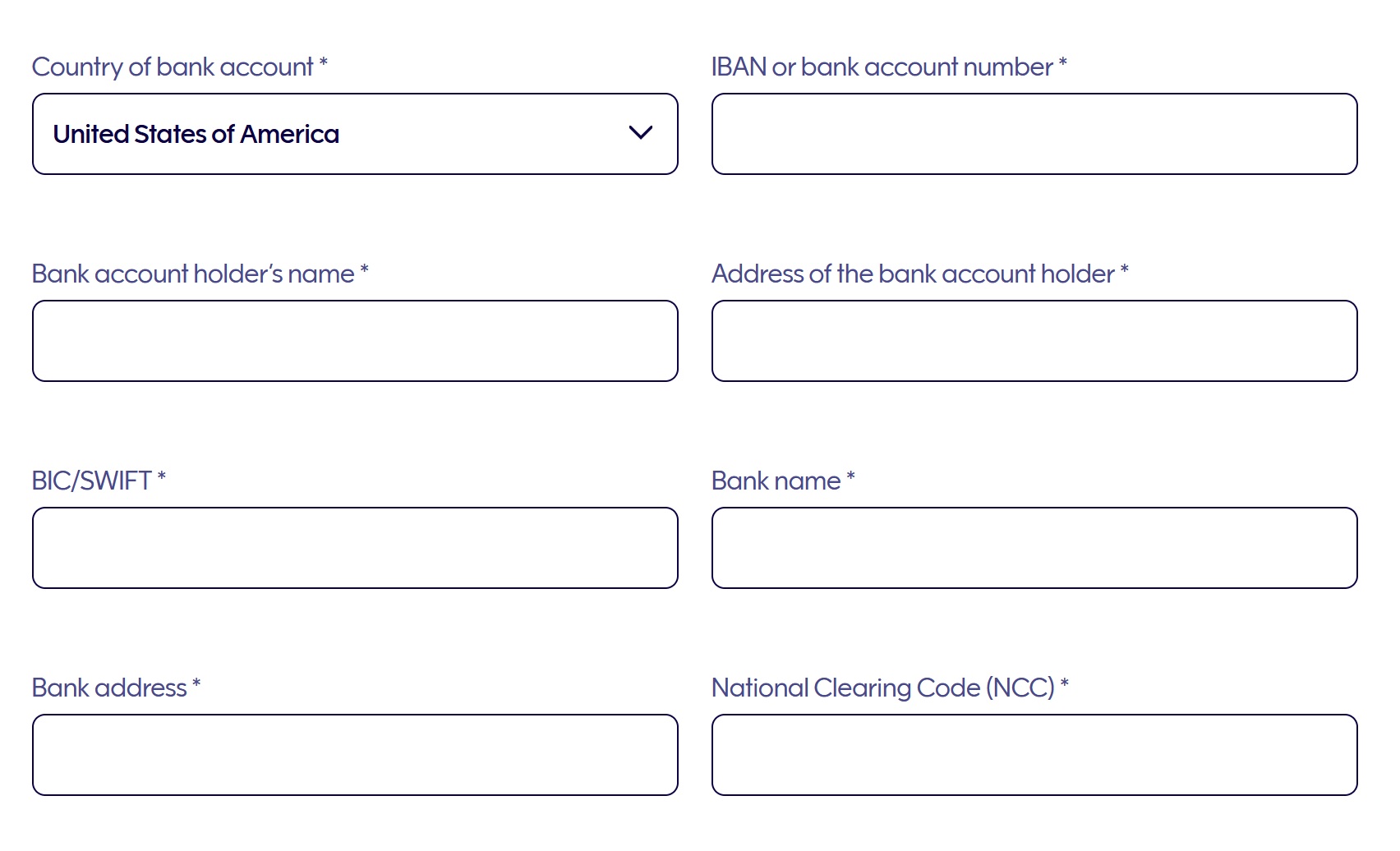
You need to enter your bank’s SWIFT code, which is sort of like a routing number for international transactions. That isn’t the same as your bank account’s routing number, though you’ll need that, also. You’ll want to Google for your bank’s SWIFT code and make sure that you’re getting a result from your bank’s website to confirm it. Also note that the form requests a National Clearing Code (NCC). Based on a quick Google, it seems that this is a more common foreign term for routing number, so that’s where the account’s routing number belongs.
After filling in the form and hitting submit, the confirmation message said it would take 3 to 14 business days to receive the transfer.

Bottom line
The process to file an EU261 claim with Finnair for flights booked with Alaska Atmos points was surprisingly simple. We didn’t need any special documentation, nor did I need to make any phone calls. Finnair provides simple online forms that are easy to fill out, making the claims process a relative breeze. The main bottleneck was waiting a couple of weeks for a response and then having to first accept a gift card (with 50% more value) and then take steps to convert the gift card to cash. However, I don’t think that process is unfair, and it could even be a pretty good deal. In our case, we’ll end up getting about $1,900 in USD for four passengers, though we could have alternatively taken a gift card worth about $2,850 USD that could have been used to book flights for anyone. We had no near-term plans to fly Finnair, so we were happy enough with the cash compensation and were happier still with how simple it was to claim. This process made me far more confident in filing a claim if I ever need to do so again, but since the process varies from airline to airline, I don’t expect that it will always be so simple.
 Want to learn more about miles and points? Subscribe to email updates or check out our podcast on your favorite podcast platform.



Finnair air is a disaster of an airline. Cancelled our flight from India to the USA via Helsinki 3 hours prior to the flight. Tried to get compensation. Denied as flight did not originate or end in the EU, even though there was an overnight stay in Helsinki. Never will I fly it again.
Iberia denied our EU261 claim multiple times, stating different reasons each time, none of which were applicable to our situation. I finally signed on with Air Help. Iberia promptly acknowledged the claim and paid it but cost us around $450 commission. I think the airline has nothing to lose by denying the claim. If the passenger gives up and doesn’t pursue it, the airline doesn’t have to pay. If the passenger uses Air Help or a similar resource, the airline pays the same amount it would have had to pay any way.
Us261 now!!
Bless you. That would be my dream. It’s the little things, like, getting properly compensated when the airline is at fault. An extra several hundred dollars makes a huge difference.
I can’t tell from the article. Were you given 50% more value in the form of a gift card?
He was. But if he converted to cash, he would lose that 50%
Wait so he got 50% more value in the form of a gift card? I can’t tell from the 4 times it was repeated.
Yes… but he exchanged for cash so lost that extra 50%
But was there an opportunity to get “50% more value” in the form of a gift card?
Yes. Gift card would expire in a year though, and they had no plans to use Finnair gift card
Gift card but just for Finnair. That’s a smart move because they keep the money. Turkish does something similar for refunds, the % is lower but the credit is valid for 2 years
Went thru a similar exercise 6 months ago with AF for a 3 ½ hr delay, all done online, but simpler than Nick’s. There was not a gift card step, but direct deposit in about 4 weeks into my account.
My wife and I had a similar experience in October with a flight delay on Air France/KLM. However, when TripIt advised us that we were eligible to file for compensation, we paid the exhorbitant fee charged by AirHelp. Yes it was a lot to pay, but we felt we saved hours of vacation enjoyment by letting them do the work. Nick makes it sound easy, but a close reading reveals a lot of confusing forms and hard-to-find information (for the average traveler) required to complete the process. Kudos to Nick for his work and kudos to EU261 for just compensation.
Nick, well done. And, more importantly, thank you, European Union (and the UK) for actually protecting passengers. Canada has something similar, too, called the APPR. We, in the US, could and should have something similar, but the airline lobby bribes our politicians to vote against our best interests. When the adults are back in-charge, we seriously need a compensation program for when airlines are at fault. No, it does not bankrupt airlines or increase ticket prices (see Ryainair which still offers dirt cheap fares under EU/UK261). Yes, insurance is still a good idea, but is not a panacea. We deserve better.
Good luck waiting for adults to be in charge. I don’t know of many if any adults any of the Republican or Democrat parties.
Well, if they’re corporate shills, then, yeah, sadly, both-sides do have that issue. Time to not nominate/vote for those types in any primaries, either.
Biden admin had a rule to protect passengers. Trumps FAA admin sunk it. Look it up. It’s public information. Don’t “both sides” the issue. Trumps FAA admin said it would be bad for business (to pay customers).
I am fighting Swiss Airlines so hard right now for a claim they wrongfully denied in October
Keep fighting. Not sure of your specific circumstances, but, it’s usually worth trying. Escalate. Appeal. File complaints with regulators. And, when you vote, demand better consumer protections, in commercial aviation and everywhere. We’re with you, sir.
Never give up. Never surrender!
By Grabthar’s hammer, by the suns of Worvan, you shall be avenged…
Did we just become best friends?
RIP Alan Rickman
“He has saved us!”
RIP
Swiss Air is the worst
Any tips?
To go through the opposite experience try to get compensation for a cancelled flight on JetSMART Airlines, headquartered in Chile but owned by US Investment firm Indigo Partners of the USA.
Awesome and simple. Just like BILT 2.0
No, EU261 is nothing like BILT 2.0. Yes, EU261 should be even easier, and, unfortunately, airlines, like Finnair do try to delay and fight you on claims, sometimes. However, to compare an excellent regulation like EU261 to a botched credit card transition is laughable.
I think the /s was implied
I bit the onion…