The Coffee Break podcast last week, where Greg and Nick talked about the trials and tribulations of podcasting from the road, reminded me of some of the big pain points I experienced in my nomad years, especially as I attempted to work from the road. I wasn’t podcasting at that time, but video editing was a big part of my daily tasks, so I was traveling with plenty of equipment, just like Greg and Nick. And even though I’m not a nomad anymore, I still work remotely and find myself with plenty of work-from-the-road days.

Here are the 9 things I’ve learned to make work-from-the-road days a little easier:
- If I’m staying in an Airbnb abroad, I search the reviews for the word “Wifi”
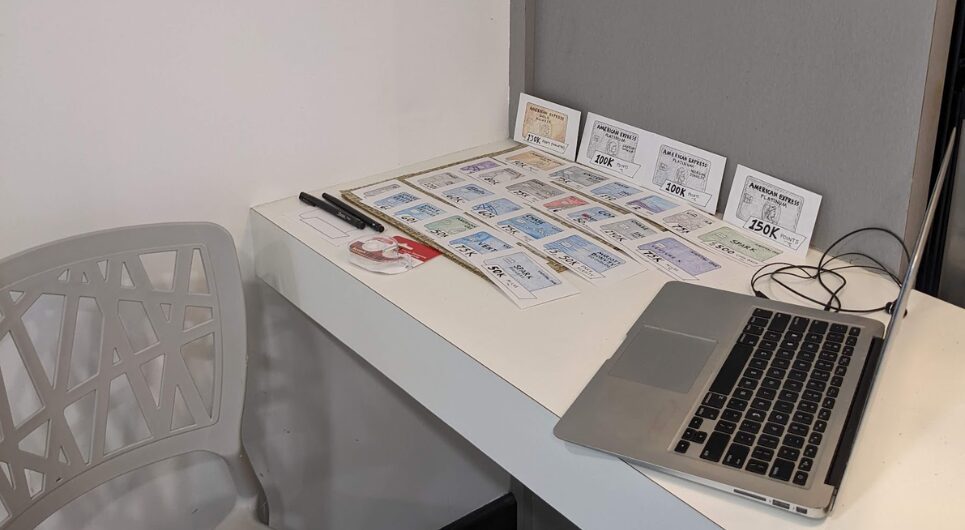
Here’s a snapshot of when I participated in the 3 Cards, 3 Continents live card draft from an Airbnb. In the States, if an Airbnb has wifi listed as an amenity, chances are it’s going to be reliable for work. But internationally, I’ve found that not all wifi is strong enough for actual, reliable work. (At least not the kind of work I need to do with Zoom calls and file downloading and uploading.) So if I’m counting on an Airbnb for my accommodations, I don’t just rely on the inclusion of wifi in the listed amenities; I actually search the reviews for the word “wifi” and see if someone has commented on its workability.
- When traveling abroad for longer stretches, I buy a local SIM card.
For shorter trips, I don’t mind paying the $12 a day Verizon charges for international data (a feature that needs to be activated). But if I’m staying somewhere longer than 2 or 3 weeks, I’m more likely to get an actual local SIM card. This is usually fairly cheap (~$50 or less per month) and allows me to select the provider with the best service for the area. This is especially important in more remote areas. (I’ve never used an eSim, but if anyone has experience with eSims, please comment below!) - Even if I’m trying to travel light, I still try to bring some kind of laptop bag

This little red backpack wasn’t very sturdy, but it didn’t take up much space in my suitcase, so I could meet restrictive baggage allowances and have a spare backpack to carry my laptop around town. I do a lot of carry-on-only (or even personal-item-only) travel, so this one can be hard. But even a well-constructed reusable grocery bag is better than carrying a naked laptop in your arms if you ever want to go work from a local coffee shop for a while.
- I avoid transit on days with scheduled meetings
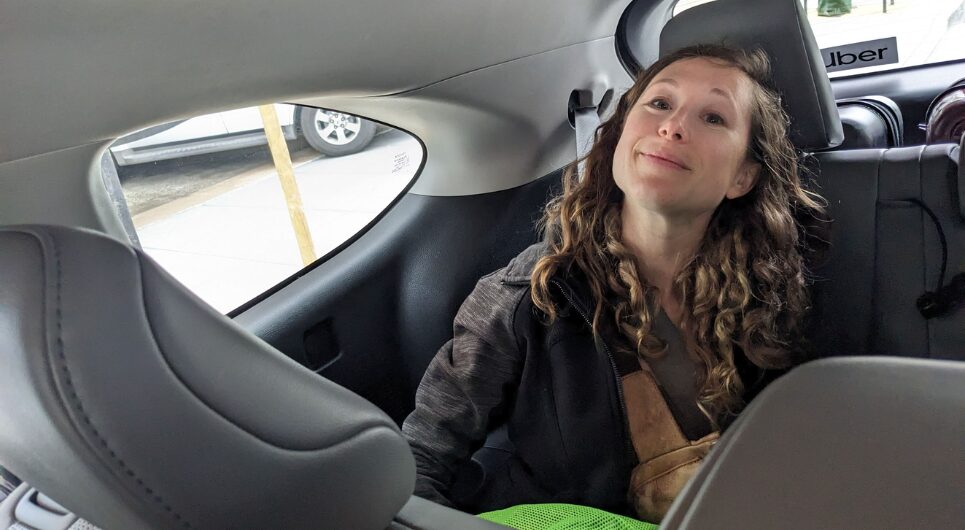 Sure, I’ve taken meetings from taxis, cars, buses, or even trails out in the woods, I hate to admit. But those meetings have been stressful and required a lot of focus just to pay attention. I don’t really have the patience for that anymore, so now I do my best to plan for a stable, quiet, work-friendly place to be, not just during my meeting but the hour before, if I can.
 - But just in case, I keep video call apps on my phone (Teams, Zoom, Google Hangouts, etc).
When I worked freelance with a whole portfolio of clients, I made sure to keep every major video conferencing app on my phone – Teams, Zoom, and Google Hangouts. And I used them all. (Now I only need the apps we use at Frequent Miler, like Slack and Zoom.) Traveling in India and Sri Lanka, this came in handy even if I was just working from the hotel room, because the power would go out sporadically, and I would have to take the meeting from my phone using my phone’s data (to preserve battery, since hot-spotting can take up a lot of battery.) - I don’t assume I’ll be able to work on planes (or trains)
I’ve had connectivity issues on flights and almost every Amtrak ride I’ve been on as well, so I try not to assume either of these environments will be solid opportunities to get work done. If they are, it’s a pleasant surprise, not something I rely on. - Bubble wrap fragile things!
When I used to travel with external hard drives (before cloud storage was so affordable and ubiquitous), I would wrap my hard drives in bubble wrap. This successfully kept them safe during transit (until I dropped one while actively using it in a hotel, but that’s another story.) I also stored the hard drive in a cardboard box, and then eventually a hard-shelled laptop bag so that it was extra protected. - I keep my laptop bag up front with me in taxis.
Poor Greg learned the value of this during our Party of 5 Team Challenge when his bag was stolen out of the trunk of our taxi. I treat my laptop bag like my purse, and I just keep it on me at all times during transit. On a flight, it’s the bag I put under the seat in front of me, and in a taxi, I keep it up front with me too. - Cloud storage makes it easier when something does get stolen.
Even so…I’ve also had my bags stolen from the trunk of my locked rental car (in broad daylight), so it’s impossible to completely eliminate the risk. While it always sucks to get a laptop stolen, it sucks less when I’ve been good about backing up important files into the cloud. Personally, I use Google Drive. I don’t do automatic backups, but I try to maintain a monthly routine of backing up critical files into the Drive.
Please add your tips below so we can round out this list even more. What are the little things you do while you work from the road?
 Want to learn more about miles and points? Subscribe to email updates or check out our podcast on your favorite podcast platform.