

Many Chase credit cards now come with monthly Instacart coupons, good for either $10 or $20 off an order. For a long time, I ignored those coupons. There aren’t any delivery stores in my vicinity, and placing multiple pickup orders seemed tedious. I long labeled it as not worth the effort, even after having read Greg’s excellent post on ways to stack savings on Instacart orders.
Then, a few months ago, my eyes finally opened on this. Yesterday, there were a number of discussions in our Facebook group about the value of these credits, with some folks being relatively enthusiastic about them and others being convinced that they’re absolutely worthless. In this post, I wanted to share how I’m using them and why I’m kicking myself for not getting started sooner.
Our household credits
My wife and I have quite a number of Chase co-branded cards and a few Ink cards as well. Across our two Instacart accounts (we each have an account), we have:
- 3 cards with $20 monthly Instacart credits
- 7 cards with $10 monthly Instacart credits
That’s $130 in total monthly Instacart credits. We actually have a couple more cards that we could put in another account for another $30-$50 per month, but we haven’t done that yet.
Each card also comes with three free months of Instacart+, so my Instacart account isn’t scheduled to be charged for membership until May of 2027. I had gotten about two years of free Instacart+ by stacking the various credits. My wife originally only stacked for six free months, so (by my mistake!) she did get charged for Instacart+ a couple of months ago. We’ve since added another card or two to her account, which has extended her membership until May 2027. We will evaluate whether or not to keep her membership based on the savings we see over the coming year.
Unfortunately, those credits can’t all be used on a single order. If they could, the savings would be easy. Instead, the way the Chase Instacart credits work, we get 10 separate coupons that need to be used on 10 separate orders. Some will find that to be an unbearable inconvenience.
On the flip side, I look at that and say that even if I only save half of that value, that’s $65 per month. Over the course of a year, it would be almost $800 in savings. In a hobby where we often go out of our way to earn an extra 1-2% cash back, leaving eight hundred bucks a year on the table would be a shame.
And in fact, once I finally got to prioritizing the use of these credits, I realized that I had been leaving too much money on the table for too long.
My monthly use of Instacart credits
Again, I’ve had free Instacart+ for the better part of a year already and I still have about 11 more months of free service. With Instacart Plus comes free delivery. Yes, you tip on a delivery, but that doesn’t necessarily work out to make it a bad deal. For instance, on a $10 order, the suggested 20% tip is $2. In some cases, you’ll get hit with a $2.49 service fee. Let’s further say that Instacart marked up the cost of your groceries by 30%. That would mean that you’d be getting $7.69 worth of groceries for $4.49 tip. That’s a savings of $2.20. In other words, you’d be getting more than 28% off on each $10 order.
In a hobby where we might have a spirited debate over whether it makes more sense to earn 3 points per dollar with a Citi Strata Premier that has a $95 annual fee or 4 Amex Membership Rewards points with a Gold card that has a $325 annual fee (on up to $25K per year in US Supermarket purchases, then 1x), I think we can all agree that saving 28% on groceries is probably more significant.
That said if you only had one qualifying Chase card, would you go out of your way to save $2.20 per month? Probably not and I would say that’s reasonable. But if you have a number of qualifying Chase cards, the savings start to really add up. If I saved 28% on my $130 in monthly credits, that would be $36.40 in savings. Over the course of a year, that’s $436.80 in savings. Keep in mind that assumes I only placed delivery orders, I tipped 20% on those orders, and my store marked up prices by 30%. In reality, there are numerous stores where you can get in-store and member pricing. Then, the savings become significantly better. If you’re getting an actual $10 worth of groceries for that same $4.49, then your savings of $5.51 is more than 55%. If I were able to save 55% on that $130 per month in coupon credits, it would represent a real-world savings of $71.50 per month for me. That’s $858 per year.
Unfortunately, I don’t live within a delivery area, so instead I place pickup orders. It varies from store to store, but I think in most cases stores charge a $3.99 pickup fee unless you spend $35 or more.
Some people just make the effort to place orders of $35 or more in order to use these coupons. Personally, I don’t worry about that. I prefer to use all of the coupons in one shot and to avoid spending extra out of pocket. We place all of the orders at once for pickup at the same store. Yes, that means I pay a $3.99 pickup fee per order. I’ve gotten pretty good at getting my orders very close to exactly $10 or $20 so that I’m just paying a little over $4 per order.
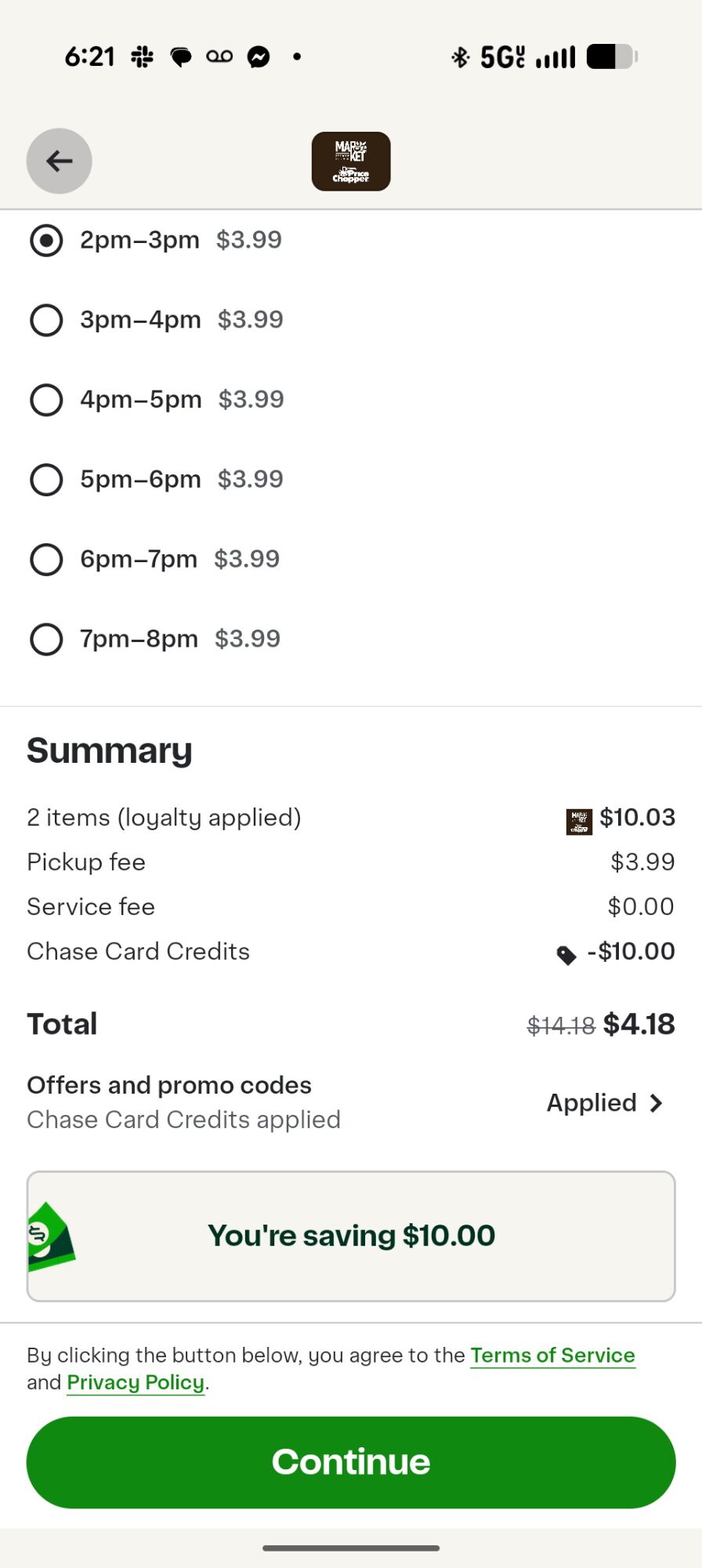
For the sake of keeping simpler math, let’s say that I’m spending $5 per order across my 10 monthly orders. That would be $50 out of pocket each month for $130 worth of groceries, at a savings of $80 per month. It would be $960 in savings each year just by using these credits. If my real-world results are closer to $4.50 per order, then I would be looking at another $60 per year and have saved over $1,000.
Even if my store did not have in-store pricing available online and Instacart were charging a markup of around 30% on groceries, I would still be getting $100 per month in groceries for $50 or less out of pocket, for a savings of 50%. Saving $50 per month would mean saving $600 over the course of the year. Whether you are able to get in-store pricing or Instacart is marking up the price of the goods you are buying, the savings here are real. In fact, the savings are good enough that it might even get me to consider keeping an Instacart membership when this is all over.
Again, in the context of the many things that we do to save money here or stack a few extra miles there, the money I’m saving on groceries far outpaces many of the smaller deals that I chase.
The mechanics
The biggest pain point for me in stacking Instacart credits is that the process for placing multiple orders is not intuitive. That’s because once you place a single order, if you go back to the same store, and you add something to your cart, it’ll add it to the existing cart. Even though you already “checked out”, Instacart will assume that you want to add it to your existing order. But, since you need separate orders to use separate coupons, you don’t want to add to your existing order.
Instead, once you complete checkout for an order, whether you’ve chosen pick up or delivery, you need to go back to the store page and, before adding anything more, go to your cart by clicking the green button at the bottom that shows “View Order” / a cart icon.
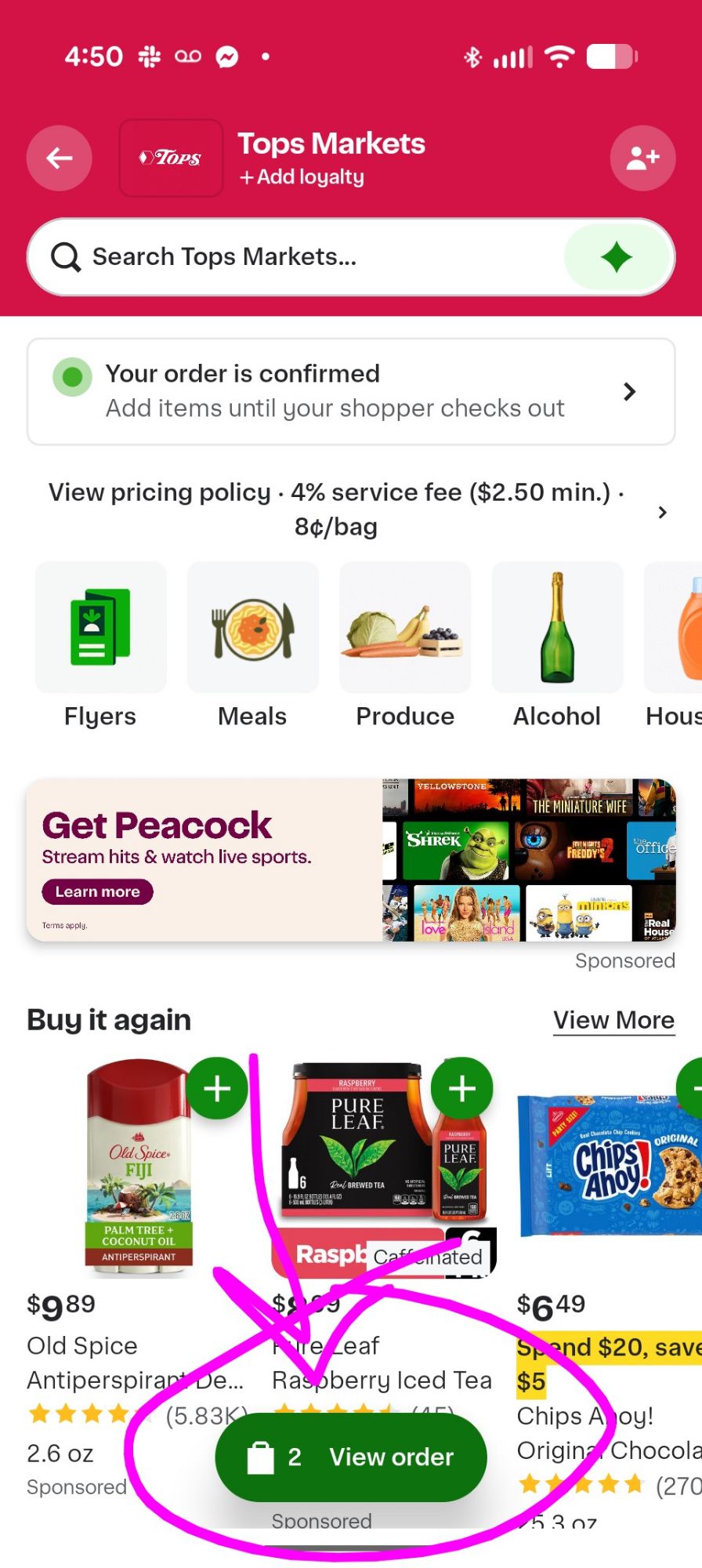
Once in the cart, in the top right-hand corner, click the words “New Cart”.

That’ll start you with a fresh cart where you can add items and check out again. Then, repeat. Go back to the store page, click your cart, click “New Cart”, and go ahead and place your next order. You don’t need to change the payment method every time. For instance, if you have 5 co-brandex cards at each, have a monthly $10 credit. You just need to set your payment method as any one of the co-branded cards. You could actually pay your $4 pickup fee with the same co-branded card all five times and you’ll be able to use the five separate coupons. Again you don’t need to switch and pay for one order with each of your co-branded cards.
If you want to use a $20 coupon that comes on one of the Ink cards, then you do need to switch to an Ink card for your payment method in order to use a $20 credit.
We do that whole process either once or twice each month, depending on our grocery needs.
When I go to pick up six or ten orders in my name at the grocery store, I definitely get a curious eyebrow now and then and sometimes a helpful employee explaining to me that by placing multiple orders, I’m paying the $4 pickup fee multiple times. Sometimes I explain, sometimes I just thank them. Either way, I’m able to place my pickup orders and pick them all up in one shot.
Occasionally, I’ll run into a store that will run out of pickup times because they only offer a certain number of pickup orders per hour. In those cases, I’ll just continue to place orders with earlier pickup times, knowing that the store will keep the items in the cooler until I arrive.
In the rare instance that a store sells out of all its pickup slots for the day I need, I have been known to place a delivery order to a place where I am planning to be. I don’t prefer delivery because Instacart doesn’t always meet expectations with deliveries.
Instacart headaches
Despite the monthly savings I’m stacking, I’m not the biggest cheerleader for Instacart. There are definitely some headaches and pain points involved with using these credits.
I ran into an issue last weekend when I placed a number of delivery orders for delivery between noon and 2:00pm. I had plans to be in a specific place from noon until 2 p.m. A couple of those orders got delivered around 1:50 p.m., but then several of the rest of the orders got updated to delivery times around 3:00 pm or even a little later. I wasn’t going to be there at that time, so that didn’t work for me. I had to cancel those orders and place them again for pickup at a different store the next day.
Speaking of cancelling, that isn’t intuitive. You need to go to your order, then hit “help” in the top right corner to get to the ability to cancel.
I would probably dislike Instacart more if I did more delivery orders. That’s because in the handful of delivery orders that I’ve done, I’ve frequently found that there are mistakes. Furthermore, not all shoppers are particularly conscientious about buying fresh-looking produce or making sure that the details match what you asked for. While you can follow up with customer service, that becomes a problem because after just a couple of complaints, customer service flags your account for having too many problems. I find that really annoying because in most cases the problems are created by employee errors, yet Instacart will be quick to ding your account for too many complaints if you, through no fault of your own, don’t receive your items or receive the wrong items.
As a result, I am not very interested in taking advantage of delivery. I’m perfectly happy to pick up my orders at the store, where I know I can more likely get a mistake corrected right away. I also find that, at least in my experience, when store employees are doing the shopping for the pickup orders, I tend to get what I asked for. We’ve had very few problems with pickup orders in general.
My wife was initially very hesitant to use Instacart for produce, but that’s become our core use of these credits. We have two young sons who go through a ton of fruit every month. One of our sons is almost a fruitarian. Any parent shopping for fruit knows that it gets expensive quickly. Saving $50-$70 per month on fruit is a terrific deal for me. The vast majority of our Instacart orders are for strawberries, grapes, oranges, blueberries, raspberries, blackberries, cherries, bananas, apples, pears, mangoes, and all of the other fruits.
I try to avoid ordering avocados because so few people seem to know how to pick out a good avocado, but we’ve had good luck with other items. Fruit also comes in handy as fillers; if I have a cart that adds up to $9.XX, I can usually count on adding a single banana or a single apple or tomato or other produce item to make up the difference and get me to just over $10 or just over $20. Those $20 credits are especially useful because $20 worth of groceries for about the $4 pickup fee makes it easy to come out well ahead. The fact that many no-annual-fee Ink cards come with a monthly $20 credit is absolutely phenomenal, in my opinion. I use all of our $20 credits, never letting them go to waste. In fact, we have another eligible Ink card and could downgrade an Ink Business Preferred to another eligible Ink card, and it might make sense to have another Instacart account for those two $20 monthly credits even if we ultimately have to pay the ~$106 per year for membership. That’s less than $9 per month, so if we could unlock two more monthly $20 credits that each cost us less tan $5 to use, we’d end up with another $40 worth of groceries each month for about $19 (~$5 after pick up fee and any overage x 2 cards + ~$9 per month for membership).
If you do have Instacart credits that would otherwise go to waste, it is possible to donate those credits by picking up Instacart Community Cards. We’ve written about that before. Essentially, you can shop for local food banks through Instacart Community Carts using your credits.
Bottom line
I ignored the Chase Instacart credits for a long time, determining that it wasn’t worth my time to save four or five bucks on groceries. However, as I came to see the value in these, I realized the significant percentage I was leaving on the table and the significant savings it adds up to over the course of a year if you’ve got multiple qualifying Chase cards in your household. Since my wife and I have been in the hobby for a long time, we have quite a number of Chase cards, and so we stand to save a nice chunk of change each month with Instacart.
I would probably hate this benefit if the majority of my orders were delivery orders, simply because I think there are very frequent mistakes in Instacart deliveries, and it’s so hard to know whether or not you’ll get a good shopper. Since we don’t mind planning a pick up once or twice a month, we’ve been really happy with the results, enjoying a nice discount on fruit that we will buy with or without credits to use. Over the course of a year, we have likely saved over eight hundred bucks thanks to the Chase cards we have with Instacart credits. In most cases, those are Chase cards that we would be keeping, whether or not they had the Instacart credits, so this really kind of feels like found money.
 Want to learn more about miles and points? Subscribe to email updates or check out our podcast on your favorite podcast platform.



Buy the way are you also going through Rakuten to place your orders?
Dammit Nick. You talked me into it. I hate Instacart but your right. The fruit juice is worth the squeeze. Nice post
How do you use the multiple coupons? I added 3 different cards (CIC, CIU and United Biz) in the account and i only see one 20 dollar off. I can’t seems to be able to use the other coupon after I use the first one.
Nick has to place a separate order to use each and then he pickups multiple orders at once at the store.
The markup makes these worthless.
Instacart for Costco is priceless for the other currency saved (time).