

Co-branded credit cards, and hotel cards specifically, are often frowned upon as a place to put regular spend, especially in comparison to bank cards with transferable currencies and sexy bonus categories.
That said, hotel cards can be both rewarding and fun in the right circumstances. The reason is that they tend to have a ton of perks that are offered for holding onto the cards and also for spending on them. These usually include some combination of points bonuses, elite status, elite-qualifying nights, and/or free night certificates. We collectively refer to these cash carrots as “Big Spend Bonuses.”
The purpose of this post is to take a closer look at the top hotel cards with big spend bonuses in order to get a rough estimate of the return on each one…and in doing so find out which might be worth pursuing.
The post has been completely updated for 2026, now that we’ve finished our annual examination of the current value of hotel points. Although the Sonesta card is no longer available to new applicants, many readers still have it (as do I), so I kept it in for another go-round.
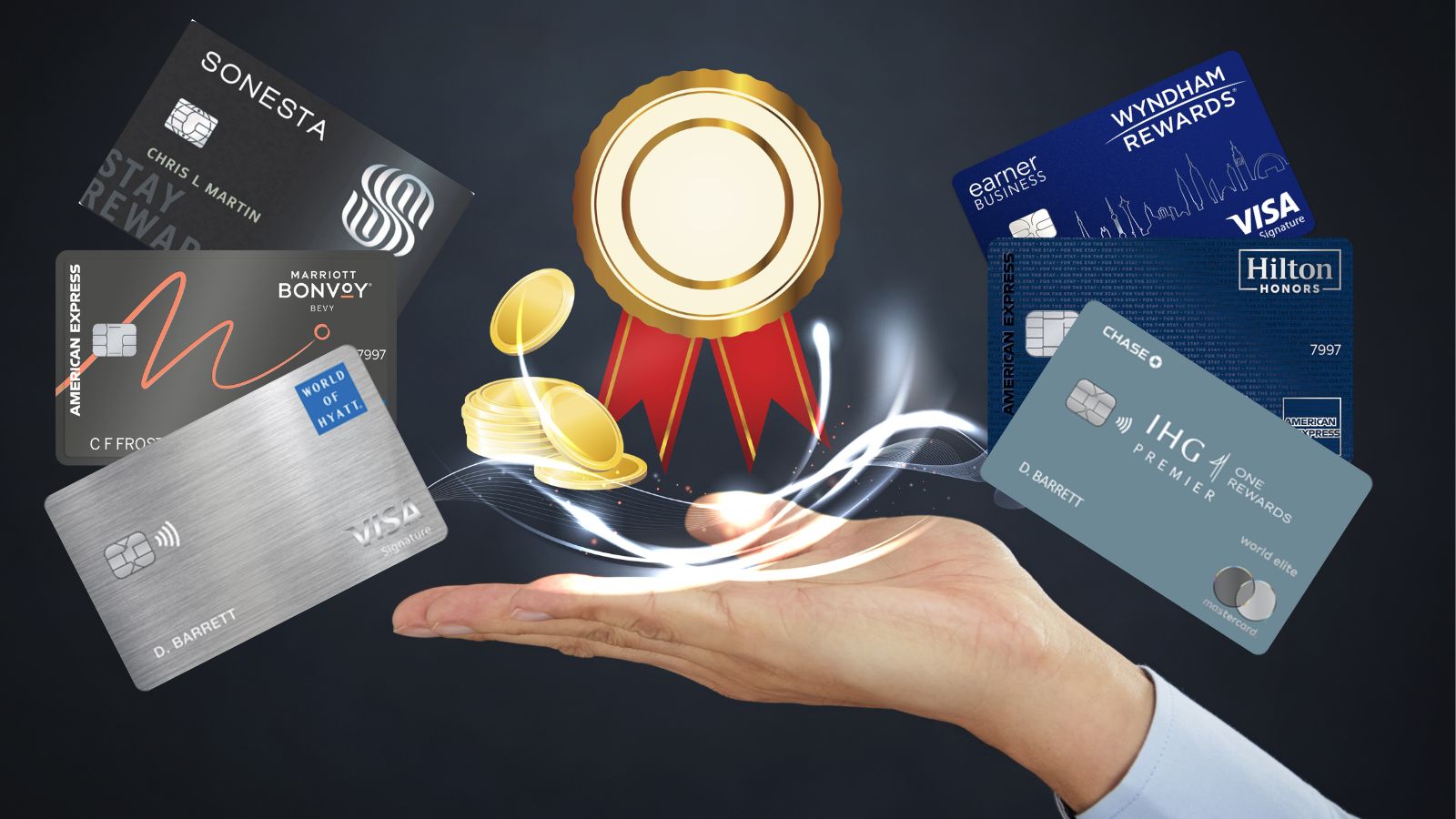
Comparing hotel credit cards with “big spend bonuses”
Hotel points, in general, aren’t worth as much as most airline miles and transferable currencies, which is the primary reason that they usually aren’t recommended for regular spending. Getting 3x Hilton points everywhere sounds pretty good…the $395 Capital One Venture X only gets 2x, after all. However, we value Hilton points at around 0.4 cents each, whereas Capital One miles are closer to 1.45 cents each, making 2 Capital One miles “worth” over twice as much as 3 Hilton points. Heck, since Hilton points are often on sale for 0.5 cents apiece, you could even put spend on a 2% cashback card and then buy Hilton points, effectively earning 4x Hilton points per dollar.
However, the various treats that banks and hotel chains offer to keep us interested can be very tasty indeed. In order to give you a reason to put regular spending on their cards, these companies offer a whole plethora of “big spend bonuses.” Earning 3x-6x Hilton points per dollar isn’t terribly compelling, but throwing in a free night certificate good at almost any Hilton property in the world changes the equation.
But by how much?
That’s what we’re going to try to examine here.
What we’re comparing…and what we aren’t
There are a few parameters to lay out first:
- We’re not factoring in anything you get just by holding the card, just what you get from spending on the card. Many cards can be worth holding and paying the annual fee simply for the perks the card bestows, be it anniversary bonuses, elite status, or regular
couponscredits (I see you, Amex). Since you’d get these regardless of whether you put a dime on the card, we’re not including them in the spending analysis. - We’re not factoring in elite nights or status gained from spend. Hotel cards often provide the ability to gain elite nights and/or status by reaching various spending thresholds. Getting two elite nights per $5k on the World of Hyatt card might be incredibly valuable for someone who needs them for a Milestone Reward or to qualify for top-tier Globalist status. However, for someone who’s only staying at Hyatt properties a couple of times a year, they’re essentially useless. Although we’ve left them out here, if they’re valuable to you, spending on one card or the other might be much more worthwhile.
- The only thing we ARE trying to compare is the total value of the points and free night certificates you earn by reaching the big spend thresholds on the cards below.
How we value hotel free night certificates
At Frequent Miler, we value hotel free night certificates based on their maximum point value and then reduce that value by a “fudge factor” to account for the fact that free night certificates expire and are less flexible than actual points…thus, they’re slightly less valuable.
Below are the fudge factors the team developed, along with brief explanations for each. These are numbers less than 1.0, so they can be multiplied by the maximum value of a certificate in order to calculate the value.
- Hilton: 0.85
- These are the least restrictive certs since they are uncapped and can be used any day of the week.
- IHG “top-offable”: 0.85
- These have the same fudge factor as Hilton certs because you can add an unlimited number of points to book more expensive rooms, so they’re easy to maximize.
- Hyatt (12-month expiry): 0.8
- Unlike Marriott or IHG, Hyatt doesn’t allow adding points to book higher category hotels. On the other hand, Hyatt’s certs work just as well at hotels that are peak-priced as at those that are standard or off-peak. This is an adjustment that we’re applying to the Chase-issued certificates with a 12-month expiration date.
- Marriott: 0.75
- While Marriott allows you to add points to top off a free night certificate, it caps the amount at 25,000 points per night.
Based on these “fudge factors,” we’ve arrived at the following values for the certificates that are included in this post:
- Hyatt Category 1-4 (12-month expiry): 15K points x 0.80 fudge x 1.7 RRV = $204
- Hilton: 150K points x 0.85 fudge x 0.41 RRV = $523
- Marriott:
- 35K points x 0.75 fudge x 0.77 RRV = $202
- 50K points x 0.75 fudge x 0.77 RRV = $289
Note that we’re using 150k points for the Hilton certs, even though they can be used for properties that cost up to 250k/night. However, there are only around 25 of those 250k properties; 95k-150k is much more common. So, we’ve decided to keep the “points maximum” for determining that value at 150k.
The Contestants
Hilton Aspire (Amex)
| Card Name w Details No Review (no offer) |
|---|
$550 Annual Fee Earning rate: 14X Hilton spend ✦ 7X US restaurants, flights booked directly with airlines or amextravel.com, select car rental companies ✦ 3X on all other eligible purchases ✦ Terms & Limitations Apply. Card Info: Amex Credit Card issued by Amex. This card has no foreign currency conversion fees. Big spend bonus: Additional free night awards after $30K and $60K in eligible purchases in calendar year Noteworthy perks: Annual Free Night Reward every year upon renewal ✦ Hilton Honors™ Diamond status ✦ Up to $400 Hilton Resort Credit per calendar year ($200 semi-annually) ✦ $200 Flight Credit (Up to $50 per quarter for purchases directly with airlines or via Amex Travel) ✦ Up to $209 CLEAR+ fee credit per calendar year ✦ Up to $100 on-property credit w/ Aspire Card package ✦ Terms Apply See Rates & Fees See also: Amex Hilton Aspire In-Depth Review |
- Bonus categories: 7x on US dining, flights, and car rentals
- Base earning rate: 3x
- Big Spend Bonus: Free night certificate (FNC) after $30k calendar year spend
- Big Spend Bonus Value: $523
Notes: The Hilton free night certificate is potentially the most valuable one out there, as it can be used for a standard room at almost any Hilton property in the world…even one that costs as much as 200,000 points per night. However, as a standalone proposition, the certificate that comes with the Aspire provides quite a bit less return than its lower-cost sibling below. There’s one, big reason for that…you have to spend a whopping $30k to get it.
Hilton Surpass (Amex)
| Card Name w Details No Review (no offer) |
|---|
$0 introductory annual fee for the first year, then $150 Earning rate: 12X Hilton spend ✦ 6X U.S. restaurants, U.S. supermarkets, and U.S. gas stations ✦ 4X U.S. Online Retail Purchases ✦ 3X on all other eligible purchases Card Info: Amex Credit Card issued by Amex. This card has no foreign currency conversion fees. Big spend bonus: Free night award after $15K in eligible purchases in calendar year ✦ Hilton Honors™ Diamond status with $40K in eligible purchases in a calendar year ✦ Terms apply Noteworthy perks: Automatic Hilton Honors™ Gold status. Hilton Honors™ Diamond status w/ $40K in eligible purchases in a calendar year ✦ Up to $200 in Hilton credits ($50 per quarter) ✦ Terms Apply |
- Bonus categories: 6x on US dining, US fuel, and US grocery
- Base earning rate: 3x
- Big Spend Bonus: Free night certificate (FNC) after $15k calendar year spend
- Big Spend Bonus Value: $523
Notes: The Surpass gives you the exact same free night certificate that you get with the blingier Aspire card, but at half the required spend. Most folks will find the bonus categories easier to exploit as well, although there are some people out there who would sooner have a hole in the head than use the Surpass at a grocery store.
IHG Premier/Premier Business (Chase)
| Card Name w Details No Review (no offer) |
|---|
$99 Annual Fee Earning rate: 10X IHG ✦ 5X travel, dining, and gas stations ✦ 3X on all other purchases Base: 3X (1.77%) Travel: 5X (2.95%) Flights: 5X (2.95%) Hotels: 5X (2.95%) Dine: 5X (2.95%) Gas: 5X (2.95%) Brand: 10X (5.9%) Card Info: Mastercard World Elite issued by Chase. This card has no foreign currency conversion fees. Big spend bonus: 10K bonus points + $100 statement credit after you spend $20K in a calendar year ✦ Diamond status after $40K in purchases in a calendar year Noteworthy perks: Anniversary free night e-certificate good at IHG® properties up to 40K points per night ✦ Ability to add an unlimited number of points to a free night certificate to book a higher-level hotel ✦ Fourth night free on award stays ✦ 20% discount on points purchases ✦ Platinum elite status ✦ Up to $50 in United TravelBank cash per year (must register your card with your United account) ✦ Complimentary Instacart+ for 3 months (must activate by 12/31/27) ✦ Up to $10 monthly Instacart credit ✦ Up to $120 Global Entry, TSA PreCheck® or NEXUS Statement Credit |
| Card Name w Details No Review (no offer) |
|---|
$99 Annual Fee Earning rate: 10X IHG ✦ 5X travel, gas stations, restaurants and dining, social media and search engine advertising, office supply stores ✦ 3X on all other purchases Base: 3X (1.77%) Travel: 5X (2.95%) Flights: 5X (2.95%) Hotels: 5X (2.95%) Dine: 5X (2.95%) Gas: 5X (2.95%) Office: 5X (2.95%) Brand: 10X (5.9%) Card Info: Mastercard World Elite issued by Chase. This card has no foreign currency conversion fees. Big spend bonus: 10K bonus points + $100 statement credit after you spend $20K in a calendar year ✦ Diamond status after $40K in purchases ✦ Free night certificate (up to 40K points) after $60K in purchases in a calendar year Noteworthy perks: Anniversary free night e-certificate good at IHG® properties up to 40K points per night ✦ Ability to add an unlimited number of points to a free night certificate to book a higher-level hotel ✦ Fourth night free on award stays ✦ 20% discount on points purchases ✦ Platinum elite status ✦ Up to $50 in United TravelBank cash per year (must register your card with your United account) ✦ Complimentary Instacart+ for 3 months (must activate by 12/31/27) ✦ Up to $10 monthly Instacart credit ✦ Up to $120 Global Entry, TSA PreCheck® or NEXUS Statement Credit |
- Bonus categories: 5x on travel, dining, and gas stations
- Base earning rate: 3x
- Big Spend Bonus: 10K bonus points + $100 statement credit after $20K calendar year spend
- Big Spend Bonus Value: $159
Notes: The IHG Premier and Premier Business are mirror images of each other in their bonus categories and big-spend bonuses, so we’ll treat them as the same card here. There’s no certificate involved, so we’re valuing the statement credit at face value and the 10k points at ~$59.
Marriott Bevy and Bountiful (Amex/Chase)
| Card Name w Details No Review (no offer) |
|---|
$250 Annual Fee Earning rate: 6X Marriott ✦ 4X restaurants & U.S. Supermarkets on up to $15K in eligible purchases per year ✦ 2X on all other eligible purchases Card Info: Amex Credit Card issued by Amex. This card has no foreign currency conversion fees. Big spend bonus: One 50K Free Night Award after $15K calendar year spend on eligible purchases. Noteworthy perks: 15 night credit towards elite status every year upon account anniversary ✦ 1,000 bonus points with each qualifying stay ✦ Marriott Bonvoy® Gold Elite Status See also: Marriott Bonvoy Complete Guide |
| Card Name w Details No Review (no offer) |
|---|
$250 Annual Fee Earning rate: 6X Marriott ✦ 4X restaurants & grocery on up to $15K spend per year ✦ 2X everywhere else Card Info: Visa Signature issued by Chase. This card has no foreign currency conversion fees. Big spend bonus: One 50K Free Night Award after $15K calendar year spend Noteworthy perks: 15 night credit towards elite status every year upon account anniversary ✦ 1,000 bonus points with each qualifying stay ✦ Gold elite status ✦ Complimentary Instacart+ for 3 months (must activate by 12/31/27) ✦ $10 monthly Instacart credit See also: Marriott Bonvoy Complete Guide |
- Bonus categories: 4x on restaurants & Supermarkets on up to $15K spend per year (Bevy is limited to US purchases for supermarkets, Bountiful is not)
- Base earning rate: 2x
- Big Spend Bonus: 50K free night certificate after $15K calendar year spend
- Big Spend Bonus Value: $289
Notes: Although they’re issued by different banks, the Marriott Bevy and Bountiful cards are also very similar in their bonus structures and identical in their big spend bonuses. The only difference is that Amex limits the 4x supermarket bonus to US locations and Chase does not.
Marriott Business (Amex)
| Card Name w Details No Review (no offer) |
|---|
$125 Annual Fee Earning rate: 6x at Marriott Bonvoy® properties ✦ 4x at restaurants worldwide, U.S. gas stations, wireless telephone services purchased from U.S. suppliers and on U.S. purchases for shipping ✦ 2x on all other eligible purchases. Terms Apply. (Rates & Fees) Card Info: Amex Credit Card issued by Amex. This card has no foreign currency conversion fees. Big spend bonus: Earn an additional 35k free night certificate (can be topped-up with up to 25k additional points, subject to resort fees) after you spend $60K on eligible purchases in a calendar year Noteworthy perks: Complimentary Marriott Bonvoy® Gold Elite Status ✦ 15 Elite Night Credits each calendar year ✦ 35k Free Night Award every year after card renewal (subject to resort fees) ✦ Complimentary premium Internet access at Marriott properties ✦ Terms Apply (Rates & Fees) See also: Marriott Bonvoy Complete Guide |
- Bonus categories: 4x on restaurants worldwide, U.S. gas stations, wireless telephone services purchased from U.S. suppliers, and on U.S. purchases for shipping
- Base earning rate: 2x
- Big Spend Bonus: 35k free night certificate after $60K calendar year spend
- Big Spend Bonus Value: $202
Notes: Since the Marriott Business card offers a “big spend bonus,” we felt like we needed to include it in this post. That said, this is undoubtedly the dog of the bunch (no offense, Truffles). The 35k cert that comes with this card requires a whopping $60k in spend. I’ll expect that we’ll learn that this should be kept in the drawer, firmly underneath the socks.
World of Hyatt Visa (Chase)
| Card Name w Details No Review (no offer) |
|---|
$95 Annual Fee Earning rate: 2X restaurants / cafes / coffee shops, airlines, local transit, fitness clubs and gym memberships ✦ 4X Hyatt and Mr & Mrs Smith Card Info: Visa Signature issued by Chase. This card has no foreign currency conversion fees. Big spend bonus: One free Cat 1-4 night certificate after $15K spend in a calendar year ✦ Get 2 elite qualifying night credits every time you spend $5K in purchases on a rolling basis Noteworthy perks: Free category 1-4 night every year upon renewal ✦ Additional free category 1-4 night after $15K spend in calendar year ✦ Discoverist elite status ✦ 5 elite qualifying nights ✦ Complimentary Instacart+ for 3 months (must activate by 12/31/27) ✦ $10 monthly Instacart credit |
- Bonus categories: 2x on restaurants, airlines, transit, and fitness clubs
- Base earning rate: 1x
- Big Spend Bonus: Cat 1-4 free night certificate after $15K calendar year spend
- Big Spend Bonus Value: $204
Notes: Along with the Hilton Surpass, this is probably the common big spend bonus that “points and miles people” go for. The cert can be used at any Category 1-4 Hyatt property, regardless of whether it’s at peak, standard, or off-peak pricing. Because of this, it could be used for a hotel that costs up to 18k points/night.
Wyndham Business Earner Plus (Barclays)
| Card Name w Details No Review (no offer) |
|---|
$95 Annual Fee Earning rate: 8X Wyndham & gas ✦ 5X marketing, advertising, and utilities (telecommunications, cable, satellite, electric, gas, heating oil and water) ✦ 1X everywhere else Card Info: Visa Signature issued by Barclays. This card has no foreign currency conversion fees. Noteworthy perks: 15,000 points each anniversary year ✦ Diamond status ✦ 10% discount on free night awards ✦ Cardmember discount on paid stays ✦ 15% discount—or the best available offer—when you purchase points with your Wyndham Rewards Earner® Card |
- Bonus categories: 8x on gas stations; 5x on marketing, advertising, and utilities
- Base earning rate: 1x
- Big Spend Bonus: None
- Big Spend Bonus Value: None
Notes: What the heck is this doing here? What might be the FM team’s favorite hotel credit card is lacking something that every other card in this comparison has: a big spend bonus! That said, this is generally considered the hotel credit card with some of the most valuable bonus categories, earning 8x Wyndham points on gas and 5x on utilities. Given that, we wanted to include it to see how the return compared to all of these other cards with big spend bonuses.
The Results

RRV = Our Reasonable Redemption Value.
Bonus Value = The approximate cash value of the big spend bonus (also listed above).
Total Value = Value of points generated through spend + cash value of bonus.
Return = Total Value / Total spend required for big spend bonus.
Return when doing all spending in category bonuses
| Credit Card | Multiplier | RRV | Spend Required | Bonus Value | Total Value | Total Return | Prev. Rank |
|---|---|---|---|---|---|---|---|
| Sonesta | 2x | 1.06 | $7,500 | $318 | $477 | 6.36% | 2 |
| Hilton Surpass | 6x | 0.41 | $15,000 | $488 | $857 | 5.71% | 3 |
| Wyndham Business | 8x | 0.7 | N/A | N/A | N/A | 5.6% | 1 |
| Marriott Bountiful/Bevy | 4x | 0.76 | $15,000 | $304 | $760 | 5.06% | 4 |
| World of Hyatt | 2x | 1.8 | $15,000 | $216 | $756 | 5.04% | 5 |
| Hilton Aspire | 7x | 0.41 | $30,000 | $488 | $1349 | 4.49% | 6 |
| IHG Premier or Business | 5x | 0.61 | $20,000 | $161 | $771 | 3.85% | 7 |
| Marriott Business | 4x | 0.76 | $60,000 | $213 | $2037 | 3.39% | 8 |
As would be expected, dropping our Reasonable Redemption Value for Wyndham Points from 1 cent per point to 0.7 knocked the Wyndham Business card from its previous perch atop this list, with the Sonesta card taking its place. The rest of the currently available cards fall into two general groupings: Hilton Surpass, Hyatt, and the Marriott cards at between a 5-6% return, and IHG, Hilton Aspire, and the Marriott Business card at 3.5-4.5%. No one will be surprised that the Surpass ranks so highly when you spend $15k in its 6x categories…but World of Hyatt and Marriott cards are much closer than they were last year. This is essentially due to Hilton points losing value in our most recent analysis, while both Marriott and Hyatt points went slightly up. We make a lot of fun of the Bevy and Bountiful…and rightly so. They’re bizarre cards with a range of perks that don’t match their annual fees. However, if you do get one for a welcome offer, spending to reach the free night cert isn’t terribly far-fetched.
Return when doing only half of spending in bonus categories
| Credit Card | Multiplier | RRV | Spend Required | Bonus Value | Total Value | Total Return | Prev Rank |
|---|---|---|---|---|---|---|---|
| Sonesta | 1.5x | 1.06 | $7,500 | $318 | $437 | 5.83% | 1 |
| Hilton Surpass | 4.5x | 0.41 | $15,000 | $488 | $765 | 5.10% | 2 |
| Marriott Bountiful/Bevy | 3x | 0.76 | $15,000 | $304 | $646 | 4.30% | 5 |
| World of Hyatt | 1.5x | 1.8 | $15,000 | $216 | $621 | 4.14% | 6 |
| Hilton Aspire | 5x | 0.41 | $30,000 | $488 | $1,103 | 3.68% | 3 |
| IHG Premier or Business | 4x | 0.61 | $20,000 | $161 | $649 | 3.25% | 7 |
| Wyndham Business | 4.5x | 0.7 | N/A | N/A | N/A | 3.15% | 4 |
| Marriott Business | 3x | 0.76 | $60,000 | $213 | $1,581 | 2.63% | 8 |
There’s a back-and-forth to consider when spending in hotel bonus categories, because it theoretically could take bonused spend away from other cards that might provide a greater return. Looking at the return when doing half of the required spend at base levels, we effectively see the same groupings we saw before, just at less attractive levels.
Return when doing all non-bonused spend
| Credit Card | Multiplier | RRV | Spend Required | Bonus Value | Total Value | Total Return | Prev Rank |
|---|---|---|---|---|---|---|---|
| Sonesta | 1x | 1.06 | $7,500 | $318 | $398 | 5.30% | 1 |
| Hilton Surpass | 3x | 0.41 | $15,000 | $488 | $673 | 4.48% | 2 |
| Marriott Bountiful/Bevy | 2x | 0.76 | $15,000 | $304 | $532 | 3.54% | 3 |
| World of Hyatt | 1x | 1.8 | $15,000 | $216 | $486 | 3.24% | 5 |
| Hilton Aspire | 3x | 0.41 | $30,000 | $488 | $857 | 2.85% | 4 |
| IHG Premier or Business | 3x | 0.61 | $20,000 | $161 | $527 | 2.63% | 6 |
| Marriott Business | 2x | 0.76 | $60,000 | $213 | $1125 | 1.88% | 7 |
| Wyndham Business | 1x | 0.7 | N/A | N/A | N/A | 0.7% | 8 |
When doing all of the required spending at base levels, things start to look pretty bleak for everything except for the Sonesta card and the Hilton Surpass. It’s impressive that Sonesta maintains a 5%+ return even when doing all the spend at 1x…but given that you’re effectively getting 5x everywhere because of the 30k bonus, it makes sense. The Hilton Surpass also maintains some appeal even when doing the required $15k at 3x. In fact, it’s about the same as doing half of the spending in bonus categories on the World of Hyatt and Marriott cards. The bottom-dwelling Wyndham Business shows why you should never put regular spend on the card, even though you happily lap up its bonus category riches.
Winner
- Hilton Surpass – The Aspire card gets a ton of justifiable love because of its extremely compelling mix of credits along with Hilton Diamond status, but the star for spend is undoubtedly the Surpass. Whether doing all the spending at 3x or mixing in bonus categories, this is the only other card besides Sonesta that hovers near 5%. The Aspire is a great card to product-change to and/or hold for the perks. The Surpass is worth spending on.
- Wyndham Earner Business – By no means should anyone put any unbonused spend on this card. That said, I think everyone should have it for gas and utilities…and its 15,000 point anniversary bonus, automatic top-tier Wyndham status, and 10% discount on award stays (which you could argue adds even more value to the bonus categories). It doesn’t offer a big spend bonus…but it doesn’t have to. The return on bonus category spending is excellent, especially if you use the points for high-value vacation rentals through Club Wyndham, Vacasa, or Cottages.com.
Loser

- Sonesta Mastercard – Wait, what? The Sonesta card ranks at the top of every category; how can it be the big loser? Because, unless you have one already, that effective 5x everywhere rate on $7,500 in spend is out of reach now that Bank of America gave the card the ‘ole dirt siesta. I was a late convert to this card, and fortunately have two in my household. It stinks that it’s now a collectible.
Bottom Line
I want to reemphasize a key point about this analysis. There are many reasons to spend on a hotel credit card. I’ll still put $15k on the World of Hyatt card, despite the average(ish) returns, simply because the six elite nights that I’d earn in addition to the free night are very valuable for me in my annual quest for Globalist status. I’m sure that the same is true for others.
Hotel programs, credit cards, and travel rewards in general need to fit you, how you travel, and where you travel. Brands like Hyatt and Sonesta that are more limited geographically are incentivized to make their programs more rewarding as a carrot to keep folks interested when the massive and far-ranging portfolios of Marriott, Hilton, and IHG beckon. Simply because something is more or less “rewarding” doesn’t mean it’s more or less valuable to you. Hopefully, this post provides a good template for a way to examine how you spread out your own spending, and perhaps some ideas for further exploration.
 Want to learn more about miles and points? Subscribe to email updates or check out our podcast on your favorite podcast platform.



I recently asked in the Facebook group what people would if they couldn’t get approved for more cards. A lot of answers came back with maximizing big spend bonuses. This is a great analysis. Thanks, and please keep these types of articles coming.
If you are a Hyatt Globaliat, the most rewarding hotel card for spending is the Hyatt Business card, hands down.
You guys are missing the Best Western card, with $10k spend you get an uncapped free night that can be used for any property, even their higher end ones.
Unfortunately, that free night certificate is not valid worldwide. It’s only valid in the in the US, Canada, and the Caribbean. But I agree if you can make use of it the value potential is huge.
Yeah that is an unfortunate restriction and I wish they made it worldwide, but if you do any kind of domestic travel then it can be valuable. You could stay at their high end hotel in the middle of Manhattan which goes for over $400 a night with the certs, which you likely wouldn’t be able to do with a FNC with card with comparable annual fees.
Great article Tim, thank you!
I’m going to buck the trend a little bit and advocate for (limited) spending on the IHG Premier Personal or Business card. Between P2 and I, we both hold each card which grants a 40k point “flexible” FNC each card anniversary year that can be topped off with an unlimited number of IHG points. Therefore, in various parts of the year, we hold up to four (4) of these at any one time.
In the recent past, we put spend on our IHG Premier Business cards and stayed at IHG hotels (hello volleyball!) to organically earn IHG points in lieu of transferring from Chase. We then use these points to top off our FNCs at HIGHLY cherry-picked properties where our points are getting incredible value.
For example, this past spring break, we used our 40k flex FNC and topped it off with 30k IHG points for a fifth night at the Kimpton Seafire (we used our 4th night free on points benefit for the other four nights). That one night would have cost well over $1,000. Essentially, we paid $95 (annual fee) for the FNC and got roughly $900 in value for 30,000 IHG points (3 cents/point).
Using the multipliers above, that’s like getting 15% back on travel, dining, and gas, and another 9% back on non-bonus spend!
Obviously, this is a specific use case. But, I think the sneaky good opportunity to top off these 40k flex FNCs makes spend on the IHG cards more compelling than it may otherwise seem.
Tim, excellent article. Thanks.
I never bother with keeper cards because I rather spend on new card SUBs but a related consideration is hitting the big spend bonus on the first year when you are already half way to the spend bonus because you spent towards the SUB.
I think you really need to discount the Marriott Business card (and, to a lesser degree, the Aspire and IHG cards) by the fact that the spend requirement is so high that most people won’t be able to put enough spending on the card to hit that big spend bonus.
Additionally if you definitely intend to open X particular cards (say, 3) this year, and if having to also spend $60/$30/$20k to hit the bonus on these hotel cards causes you to not be able to get SUBs on those 3 cards, that would be especially harmful. The harm is less when the spend causes you to miss your 8th most valuable SUB than your 1st most valuable SUB.
So, I would add an additional fudge factor by the % of people who are going to come up short on that required amount of spend.
(Another fudge factor is that most people would never pay $488 for a hotel room. So, using a “what would you pay” valuation of a free night credit starts separating considerably from the “cents per point” valuation the more expensive that hotel room gets. This is the same analysis as why you don’t value airline points according to the value of the most ambitious redemption (say, ANA First Class,))
Someone might fairly use the $488 number when booking a bucket-list property. For example, using a Hilton FNC at the NYC Waldorf Astoria. Just a thought.
True, but my point is that (1) most people won’t use the fnc for the $2k a night bucket list property, and likely not even the $488 luxury hotel; and (2) even if they would, most people wouldn’t pay nearly that much out of pocket. So the value to them is much less.
The $488 number is a suggested valuation – each person can adjust that value for what they are realistically going to do and redo the math themselves.
Fair enough, and I think Tim explains that here as well as in the rrv article. This is an art not a science. This still doesn’t touch the issue that most people aren’t going to spend $60k on their Marriott card.
This is not in my salary range, but there are people out there who spend far more than they could do in sign-up bonuses a year, so these big spend bonuses help spread out those SUBs a little more to play within each bank’s rules.
(I don’t focus on category bonuses, but these are the people that certainly will, as well as your spend increases beyond your ability to constantly hit SUBs)
Actually I am finding more and more hotels in that $500 range that used to be $250. Friday and Saturday nights in Las Vegas are way more commonly priced at $500, than most people realize. Have you checked hotels in NYC lately. One is lucky to find a hotel night in a decent property for less than $300/night.
The famous points and miles legend of only unicorns pay for first class and 4 and 5 star hotels. 10’s of thousands of people payed 500 and up just last night for hotel rooms and will again tonight. I believe some of those people would consider themselves most people.
I got the Sonesta card a year ago when you all advised me not to siesta. I got the SUB and 30k bonus for additional spend. I don’t plan on continuing to spend on it. Is there any reason to keep it considering it is no longer available for new applicants?
FM commenters are struggling with reading comprehension today.
Only today?
What about Hilton business card with 5x everywhere ? I would think that should rank 1 if all spend in non bonus category.
I’m guessing the FNC after spending $15k outperforms the extra 2x everywhere? Assuming 5x$15000=75000 points vs 3x$15000=45000, resulting in a 30000 point difference. That 30000 point difference is about $123 based on the .41 cent/point value. Maybe spending over the $15000 limit used here the gap will close since there isn’t a second FNC to earn to offset the earnings?
I think it would make more sense if you just compared personal credit cards vs throwing in several Business Cards in the comparison. Some of us don’t own businesses or want to go through the hoops of trying to apply for a business credit card even if we don’t own a business.
But, others of us DO own a business and might hold one of the business cards and DO appreciate the coverage.
I think the above assessment misses the mark on Hilton just a bit – with Aspire, you get a free night with Zero spend annually, and $30k is the second free night. The Surpass you have to spend $15k to get one night. When you consider $550 to get a Free Night (which I’ve found places you can get nights worth $750-$800), $400 towards Hotel stays, and $200 flight credit, plus 14x on Hilton stays, the card is highly valuable. To your point: maybe not an everyday card though unless someone’s a Hilton enthusiast.
I tried to cover that in the post here. I completely agree, if you’re deciding whether or not to keep a card, you should certainly factor in benefits that you get from simply holding the card.
But that’s not what we’re doing here. We’re trying to examine how rewarding it is to use these cards for spending towards their big spend bonuses.
As I laid out earlier, you’d get that annual free night, as well as the flight and resort credit, regardless of whether or not you put a dime on your Aspire card. Because of that, it doesn’t really tell us anything about how valuable spending on the card is, even though it does tell us a lot about how valuable it is to hold the card.
Also, although it’s only tangentially related to what you’re saying, you might enjoy checking out this post regarding ways to “double-dip” the benefits of the both the Surpass and the Aspire.
Don’t quite agree with the assessment on Hyatt card. Say I spend 15K in non-bonus category, I will get 15K points plus one free night cert. 15K can easily cover 3 nights in many Hyatt Place, then the cert can get me a hotel room easily above $200, you say the combined value is only $459? I think it is at least >$600.
That’s completely fair. These values ultimately come down to our Reasonable Redemption Values for hotel points, which are based on observed median hotel cash prices in the US…meaning that 50% of redemptions that we tracked were worse value and 50% were better. We always look at 60-90th percentile awards and publish those as well, for those who are willing and able to cherry-pick good value awards.
The math behind the valuation is 15,000 points x 1.7cpp = $255 for the points, plus $255 x 0.8 for our cert “fudge factor (leading to a cert value of $204) = $459.
You can certainly do better than that if you’re conscientious and there’s no reason that you can’t use your own value estimation in lieu of the median values that we use – and that probably means that the other certificates and points bonuses would be of higher value to you as well.
The Marriott Bountiful and Bevy make very little sense as long term cards, but for a first year SUB if you are chasing Marriott points this bolsters that it may be worth spending the $15K for the 50K FNC. Since the SUB requires $4K – $6K already you are a third of the way there which only makes the return on the remaining spend more valuable.
We have both a Hyatt and Surpass card and I had defaulted to putting spend on the Hyatt card as the “right” thing to do since it gets so much love for its FNC. But as Hilton has been beefing up their high end properties and it’s looking like we may not have the spend in future years to keep doing both I’ve been questioning whether the Surpass would make more sense to focus on in 2025 and beyond. This confirms what I’ve been thinking – the uncapped Hilton FNC potential is too good to pass up, particularly if your spend is largely in unbonused categories. We have no chance of reaching Globalist so the Hyatt spend really is just for a second Cat 1 – 4 FNC, not for valuable milestone rewards. I’ll gladly keep holding the card for a $95 free night but might sock drawer it after this year.
They might be harder to quantify but is there a similar comparison among airline companion vouchers from spend anywhere on FM? In my case I’m comparing the Hyatt and Surpass cards with alternatively spending on an Aviator Silver for a double AA companion voucher as well (plus the 5K loyalty point bonus, which really complicates matters since the spend is partially for status). I’m thinking Aviator and Surpass is the future, while I drop spend on the Hyatt card and convert the first year Marriott Bountiful card to a Ritz.
I completely agree with your take on both of the Marriott mid-range cards. This gave me reason to have them in the back of my mind the next time there’s a compelling welcome offer. Being able to get the 50k cert with an additional ~$9-10k spend after meeting the SUB could be worthwhile.
While this isn’t quite what you’re asking about, but we have a post that goes through all of the various companion tickets and gives the pro and cons of each one. We’ll have to noodle on whether or not we can figure out a decent way to value them. Let me know if you have any ideas!
All these 5 50K FNC offers that Marriot likes to throw around make it harder to consider their pure points offers but I think they have a place. I wanted to accumulate points for a 5th night free redemption so P2 picked up a Bountiful card on a referral. That netted about 140K Marriott points that most importantly could all end up in my account (40K Chase referral bonus + ~100K from SUB and minimum spend that were transferred from P2’s account to mine). Since I have Platinum with Marriott we wanted to book the whole stay under my account for 5th night free plus the breakfast and potential room upgrade benefits. Being a lot of the way there we spent the remaining amount to pick up the single 50K FNC on their account.
Brilliant would have been a better SUB but P2 kept getting PUP from AMEX and I was ineligible from the 5 50K FNC offer on the Boundless a year prior. If 70%+ Marriott transfer bonuses will become regular then it would make more sense to just get another Chase or AMEX bonus and transfer, last year the highest ever bonus had only been 50% though.
For domestic companion vouchers, the Bureau of Transportation Statistics (BTS) has a page on average domestic fares based on a 10% sample of all airline tickets for US carriers. This might be a good sample set for building reasonable domestic airfare cost estimates from to place average values on those vouchers.
https://www.transtats.bts.gov/averagefare/
For business class or international vouchers… I have no idea of an equivalent data set exists to easily reference.
I think it is far better to include the free night for holding along with spend bonus
That is real world
The free night with Aspire pays the annual fee
So once the fee is covered, one cannot say it is a more expensive card
Also you need to factor in return on specific hotel spend
e.g., I got 26 points/$ at IHG when staying at HolidayInn Regents Park
10 for holding card, 10 for Plat status, and 6 for spend = 26x 0.5c = 13% value back
That beats most others
I tried to cover that in the post here. I completely agree, if you’re deciding whether or not to keep a card, you should certainly factor in benefits that you get from simply holding the card.
But that’s not what we’re doing here. We’re trying to examine how rewarding it is to use these cards for spending towards their big spend bonuses.
As I laid out earlier, you’d get that annual free night regardless of whether or not you put a dime on your Aspire card, so it doesn’t tell us anything about how valuable spending on the card is, even though it does tell us a lot about how valuable it is to hold the card.
In the same way, benefits that you get from having elite status don’t affect spending on the card either. In your IHG example, you’re getting 10x for being an IHG member (not for holding the card), 6x for being a Platinum member and 10x for actual spend on your card at a Holiday Inn. You’d get the first 16x if you put those charges on any other card while being a Platinum member (or if you paid in cash). Using the card doesn’t affect it.
The only earnings that you’re getting from actually putting spend on the IHG card is 10x…which isn’t bad. If you do a certain volume of spend on the card at IHG hotels, you could certainly factor it in to the overall value…but at 10x, not at 26x.
Unless you hit $20k in overall spend, in which case you also get a $100 credit and 10,000 IHG points.
Yep. That’s what the post is about.